Showing posts with label Lake Winnipeg. Show all posts

A Magic Portal?

Hag stone necklace 

I’m not in the habit of wearing jewelry. Probably stems from my many years of working outside. But this season, I gave myself some jewelry and I’m actually feeling more comfortable with it on than without it. It’s hag stone, picked up along the west coast of Lake Winnipeg during one of my many beach strolls. I have bigger hag stones but they’d be too heavy to wear around my neck. 

So what is a hag stone?  It’s a ‘holey’ stone and some folklorist theory suggests that the hole is a portal to fairylands. I love that whimsical notion. It’s also suggested that a hag stone can ward off evil spirits, keep bad dreams away and offer protection against sickness. 

Hag stone pen holder?

I like wearing mine mostly because it represents the rocky beach where I found it. It’s solid rock, yet somehow vulnerable enough to become holey. 

Like any stone, it’s ancient like the moon. I like to think that this particular stone was waiting for me to find it. And perhaps someday I’ll figure out how to enter through its fairy portal into another world.  Right now, I'm holding it tight for a secret wish. But my other, not-so-secret wish is HAPPY NEW YEAR of PEACE to our world. 


Hag Stone Beach?

Lake Time

Lake Winnipeg, our inland sea
I should have given Waltraut a photo op here.
Thanks for putting her on Winnipeg's bestseller list!

from Saturday's Winnipeg Free Press

Summer in September is my favourite time of the year … it’s unpredictable and every warm day is now a gift. Storm colours may be moodier and more intense, but nothing beats the blue of September skies, against golden-tinged aspen, with the Canada geese in their v-shaped flocks streaming south filling the air with their squawks of freedom.  Entering the woods is like entering a golden snow globe of scattered leaves.

Tree fungi as colourful as  flowers.

Ha! How can you tell I’m just back my annual fall retreat at Camp Morton? What a place. Totally magical.  Enjoyed chats by the fire, rock hunting along the shoreline, fungal wonders, and, as always, glimpses of another time. Pure magic.

sunset vs sunrise

A friend invited me out to Victoria Beach the other day where she'd been granted an art retreat. Driven by curiousity, I jumped at the opportunity to enter through the gates into this restricted and historical beach resort. Victoria Beach, on the east side of Lake Winnipeg, has had a reputation of being unfriendly to immigrants. 

Until the 1950s, cottages throughout Manitoba were accessed by trains. One track ran up the east side of Lake Winnipeg serving Grand Beach and Victoria Beach (along with smaller resorts) and the other track went north along the west side, serving Winnipeg Beach and Gimli areas. The different routes also meant that sun-seekers didn’t have to mingle with other races, ethnicities or classes. 

East side of Lake Winnipeg at Victoria Beach

To have a cottage at Victoria Beach meant you were a ‘civilized’ person who was escaping into nature because you had earned it … you were successful. It also meant you were probably British. You were definitely not Jewish or East European. East beach people got to walk sandy beaches and watch sunsets.

Meanwhile, the rest of us … the immigrants, the poor, and the dis-inherited … established beach communities on the west side of Lake Winnipeg. Here, we got to watch sunrises and collect stones on the rockier shoreline.  The really well-healed holiday-ers headed out straight east to Lake of the Woods, a lake offering up islands for total privacy. Again, a different train route. 

Nowadays, of course, cottage communities don’t depend on trains. A network of highways created access to many summer resorts throughout our well-laked province. Even campers like me have access to beautiful beaches. 

My parents, 1950s' immigrants, could never own a Victoria Beach cottage but that didn’t stop them from dreaming of a west side cottage.  My dad helped build enough of them in his early years here in Canada but it wasn’t until I was in high school that his own cottage finally became a reality on Valhalla Beach. 

My dad (left) at a cottage construction site, 1950s

Nearby Gimli had a thriving community of Icelanders, Winnipeg Beach welcomed Jews, and Ukrainian and Russian settlers built up other spots on the west shoreline.  Yes, the east side still has better sand and idyllic sunsets. It still holds on to a nostalgic past that still charms its privileged vacationers by keeping out the public. 

But the west side has great rocks, good fishing and ordinary people. The sunrises are amazing and promise a future that assumes equality amongst all ethnicities. 

West side of Lake Winnipeg near Gimli


stones

I’m drawn to old stuff. Old trees, old cheese, old dogs, old books, old stories. And I love old ruins. Most ruins around here, however, are made of wood and don't last too long.


But back in the 1930s, the Catholic church—under the leadership of Monsignor Morton—created a summer camp for kids called Camp Morton, where they used stones as construction materials. Using rocks, scattered along Lake Winnipeg, they created gardens, cabins, meeting halls, a water tower and more. 

The Lake Winnipeg camp was gifted to the province and made into a public resort back in the seventies and the stone structures are now neglected ruins. The old is crumbling and tumbling back into Lake Winnipeg. Huge chunks of lakeshore have dropped into the water and the stones—so artfully arranged into gardens and meeting places—have collapsed as nature once again reclaims its stones. 

If only the stones could talk.  I've been trying to listen and have imagined some interesting stories ... so maybe they do!


Writing Retreats

Photo taken from Mann's
office in Nida
Back in September, 2019 I looked forward to visiting Nida, Lithuania once called Nidden, Germany. Located on the idyllic, sand-dune covered Curonian Spit, the sleepy beach town of Nida, still honours the summer retreat of Thomas Mann. It’s a town he had to evacuate in 1933 when the Nazis delivered a charred copy of Buddenbrooks to his residence. 
Mann and his family in then 'Nidden'


I was enchanted by the view from Mann’s writing space in the picturesque blue cottage. Many writers like a natural setting while they write. The internet is full of exotic locales set deep in the woods or on beach properties to entice the muse. But for me, it's usually my own backyard that provides a natural setting for my creativity.

I often have to share 'office' with Tiberius, the cat

The ironic thing is, once a writer is in the ‘zone’ his or her surroundings dissolve as the story takes hold of the mind’s eye.  I might be sitting and watching the squirrel chasing the chipmunk when all of a sudden, I’m in a car catching the dialogue between two arguing parents as I’m transported to the other world of my novel-in-progress. 

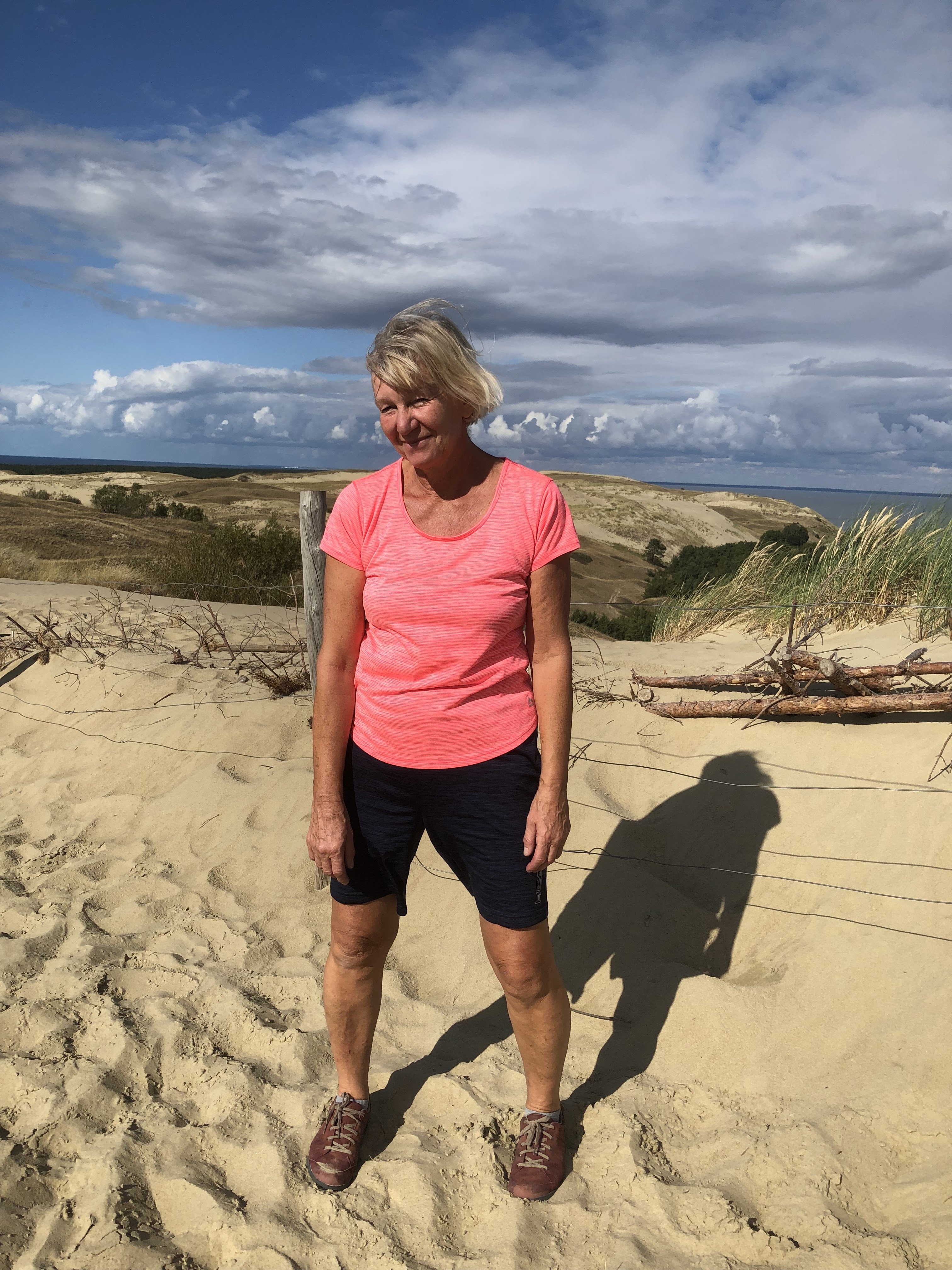
Walking sand dunes near Nida

I wonder what Thomas Mann saw looking out of his studio upon the Baltic lagoon? Did he see the crashing waves of political upheaval coming into his country? He called it the Italian view. Did it remind him of his novella, Death in Venice, published back in 1912 before he even went to Nida? 

It seems ironic, but as writers we’re influenced by our surroundings even when we ignore them. I’m heading out to my favourite writing place this coming week during this season of decay and change. I’m confident in its power to inspire me and somehow it will find its way into my stories. No doubt the waves from Lake Winnipeg’s rustic beaches will lap at the edges of my pages. 

Waves on Lake Winnipeg


Camp Morton and Time


Visiting the ruins at Camp Morton is always a highlight of my summer. The crashing of Lake Winnipeg’s waves, the sparkles on the water, and 1930s era stone mosaics touch me in a visceral way. It’s a place where history and nature embrace each other and I like to be caught in that embrace.

One of the children's cabins from 1930s
Why do I feel so connected? Perhaps, because first of all, I love shorelines. Any shoreline. I’ve ambled along the Baltic, the North Sea, the Mediterranean, the Atlantic, and the Pacific. The colours, the sound and spray of waves, the texture of the sand, broken shells, unique driftwood and always, the stones—each one containing a timeless story. Camp Morton, along the western edge of Lake Winnipeg, has such a timeless shoreline.
Water tower with 1937 in stone mosaic


Then there’s the coincidence of the camp’s dates. While Camp Morton opened in 1920,  many of the buildings are dated 1937. That's the same year my grandfather was shot in Zhytomyr during Stalin's Great Terror. The year my mom worked on some East Prussian estate in a Nazi world. For some reason, juxtaposing the serene lakeside camp with my family's losses during the Stalin and Nazi years, helps me appreciate the peaceful times I spend here at the lake. Camp Morton’s ruins are my ruins, too.

Remembering the Sisters who supervised the camp

But there’s another reason why I’m drawn to Camp Morton. It’s the religious over-tone. I spent childhood summers going to a religious camp and know it’s a perfect place to build friendships, make music and create memories.   It’s also a place where vulnerable young people can fall prey to manipulative elders with sometimes soul-sucking intentions. 

Perhaps the Fresh Air camps on Lake Winnipeg were only places of healthy recreation. But I can’t help but wonder about those children in the 1930s. Sometimes I think I hear their ghosts calling me. But it’s probably just the wind in the poplars, or the crashing waves. Or just me, casting my own shadow on the past. 

Stone fence on perimeter

Stone-clad sundial


Recent Posts

Russians from Germany featured in New Fiction

English translation published by CMU Press I read two recently published works of fiction about Germans from Russia. Both authors had signin...