Showing posts with label history. Show all posts

Sumy and Memories of Second World War

The city of Sumy in northeast Ukraine has made headlines in recent days because of the horrific Palm Sunday attacks where dozens of Ukrainian civilians died during Putin’s continued ‘special operation’ that has devastated countless lives over the last 3 years. So many needlessly broken lives. Why?

Sumy is the main city in a region I’d been hoping to visit someday. Near the ancient monastery town of Putyvl, it’s an area that has seen the horrors of war before. One of my father’s friends, an agronomist, had been stationed in Putyvl during the Nazi invasion back in 1941. 

Ernst was also from Schleswig-Holstein, like my dad, and had immigrated to Canada in the early sixties.  He’d written his memoirs and in the mid-eighties, asked me, a recent German MA grad, to translate his memoirs into English. 

I knew my family had a lot of war memories and I’d been trying to figure them out through various means … travel and oral histories, and 20th century writers like Heinrich Böll, Günther Gras and Thomas Mann so I welcomed this opportunity to get an insider’s view of that war.

File:Молчанский Монастырь 5.jpg
Fotosergio:  Molchansky Monastery

Ernst shares his efforts to keep his Nazi taskmasters happy and fed while feeding a partisan army hiding in the Sumy/Putyvl marshy woods. He shares how he supposedly manipulated the Soviets & the Nazis, killing indoor plants with too much un-drunk vodka, never being sure who to trust and even faking his own grave in an effort to hide.  It was a fascinating account and while on the outside I was a newlywed with her first house and an empty sandbox calling to her, on the inside I was learning about Nazis, partisans, Soviets and war. 


I’ve never stopped being fascinated by those years and those places. A grim reality is once again settled over  Sumy, in northeastern Ukraine and all that eighty-year-old history still matters. I’m so sad that the ‘bloodlands’ (Timothy Snyder) continue to bleed.


Imagine

I’ve spent this beautiful summer immersed in Ukraine’s 20th century troubles. I bookended Maya’s Memories, an excellent locally-written memoir, with Erin Litteken’s two recent best-selling novels, The Memory Keeper of Kyiv and The Lost Daughters of Ukraine. Made for some dark headspace. 

The fire-bombing of Dresden, as portrayed in the second half of The Lost Daughters of Ukraine, seemed particularly harsh. With friends affected by the wildfires around Kelowna, I’ve been quite aware of the side effects of smoke. My friends had to evacuate their homes and find shelter elsewhere … worried that their homes might burn. Imagine also being hungry, homeless and unable to trust those around you.

Bundesarchiv_Bild_146-1994-041-07,_Dresden
Perhaps I just have too good an imagination. Perhaps too much of a bleeding heart. Which reminds me of Marilyn French’s novel, The Bleeding Heart, which in turn reminds me of  French’s Her Mother’s Daughter, both of which I read years ago but which had a powerful impact on me. Time to reread, perhaps? Strong women characters. Men bleed on battlefields. Women bleed in other ways.

Litteken’s The Lost Daughters of Ukraine portrayed relentless suffering. From Soviet to Nazi occupation to indiscriminate bombing by the Allies and years of homelessness. It was difficult to read and I’m sure it was difficult to research and write. But it was even harder to live through. 

My weekly English sessions with current Ukrainian refugees, escaping a new war, reinforces the printed stories I’ve been reading. Every day, news headlines tell of further atrocities ... of lives turned upside down, of families separated, of uncertain futures. It keeps happening. 

Litteken’s two novels, inspired by family history, must have been a relief to get out. I know that’s how I’ve felt with my family stories. In the Author’s Note, Litteken writes, “This story—much of it dealing with painful, brutal history and with my own family’s traumas—was difficult to write. But even in the midst of the darkness, I found glimpses of light.” (p. 400)  She goes on to mention that by ignoring national identities and seeing humans first, we can learn from the past. John Lennon said it succinctly in his song, Imagine. 

“Imagine there's no countries

It isn't hard to do

Nothing to kill or die for

And no religion, too”

My friends tell me I should stop reading this stuff. That I should lighten up. Ha. I should. And I try. But I can’t ignore what’s happening in our world and I can’t ignore the past that has contributed to the present. Because it’s all connected. 


Visiting Riga

It’s been an eventful 3 years since I undertook my Baltic and Kaliningrad cycling adventure. Who knew then what a privilege travel would be? Who knew then what a precarious new chapter Russia would be introducing to eastern Europe. 


Travel has always been a privilege although many of us might see it as a right. Now with the spread of disease, the consequences of global warming and an unstable political situation, I am more than ever grateful for the limited travel I have managed to do. More than ever I scratch my travel itch through immigrant volunteer work and through books. Books—safe, cheap, environmentally sustainable and no masks or testing required. 

Still I bask in the memory of landing in Riga (about the size of Winnipeg) and embracing the crisp Baltic sunshine and all that incredible history. Riga, Latvia had never been on my travel radar before but it’s a true gem of a city. Perhaps its vibrancy is because democracy and freedom there are only 30 years old. As a former Soviet-occupied country, Riga has a living memory of political oppression.  Unfortunately, in spite of the security in being a NATO country (since 2004), by sharing a border with Belarus and Russia it has a constant reminder of its vulnerable geographical position.


Nevertheless, Latvia thrives. Its KGB museums are not rewriting history like the gulag museum in Perm in the Urals.  Last week I blogged about how the Russians continue to confabulate their own history. In Latvia, they remember the past and they sure don’t want to repeat it. Repression in countries, like repression in people, leads to illness, unhappiness and isolation. 

I’m grateful for the privilege of exploring historical Riga …a beautiful Hanseatic League port. Now it’s a place where NATO troops gather to prepare for another possible takeover. Why can’t the neighbours just mind their own business?


Cost of War

In Crow Stone (coming out with Ronsdale Press this summer), the Soviets amass at the East Prussian border and, after a quiet Christmas full of foreboding, begin their invasion in late January. It’s 1945. There have been more than five years of war. The Third Reich, aggressor state, is tired and beat. Still. . .  surrender is not an option for its Wehrmacht . . . not as long as Adolf Hitler leads the country. 

With trains overloaded and their schedules precarious, women and children travel by foot and wagon, hoping to avoid the powerful, revenge-seeking Soviet Army. 

Fast-forward to February, 2022. While we watched, the Russian Army amassed troops for months along the Ukrainian/Russia borders. Instead of a foreboding Christmas, there’s a diplomatically-boycotted Olympics to watch. A few days later, the invasion begins.  Women and children now flee via car and on foot towards the Ukrainian/Polish border. 

We in the West have been shocked out of our lazy democracies into a united front. Even conflict-shunning Germany has joined in. Can our world order be so quickly disrupted by one man? Yes. Stalin and Hitler have demonstrated the power of insanity.

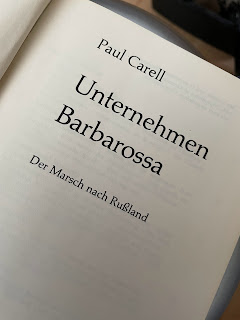
Back-track to June 22, 1941. The German-Soviet Non-Aggression Pact is broken when the Nazis invade USSR, under the code name, “Barbarossa.” Stalin, who’s killed off most of his best generals during the Great Terror of 1937/38, is initially in denial that it’s actually happening and in despair over his own naiveté. (Book: Unternehlmen Barbarossa, published in 1963)

History doesn’t repeat itself, but this is eerily similar to last century’s atrocities. Even the location is familiar. Poor, blood-soaked Ukraine. Victimized, again, and again! By communism, by Nazism, by Stalinism and now by Putinism.


But also, poor ordinary soldiers, poor Russians, trapped by an authoritarian regime. I’m struck by the news clip of a young Russian soldier, being consoled by a Ukrainian woman who offers to phone his mother for him. He’s too emotional to speak. 

I just finished reading M.T. Anderson’s Symphony for the City of the Dead. It focuses on the siege of Leningrad and the music of Dmitri Shostakovich. Powerful book, easy to read, many photographs, highly recommended.  Here’s a link to a short piece of his music written in 1943 during the siege. 

And here’s a quote from an interview with the historian and Oxford University professor, Margaret MacMillan: “There are never exact parallels, and I always resist saying that history repeats itself. The times are different, the chronology is different, the political actors are different. In fact, history can’t repeat itself because we know what happened before, so in a way that affects the decisions we make now.”

Is that comforting or does that only stoke the fear shaking our world right now?


Recent Posts

Writer's News

I’m darn happy to share a bit of my writerly journey on a podcast, ‘ A Writer’s Life ’ hosted by the gracious and fabulous host, Heige Boehm...