Showing posts with label Russia. Show all posts

Trees tell Stories

I’ve been reading Sophie Pinkham’s new work of nonfiction, The Oak and the Larch. It’s a study of Russia’s forests over the centuries. Trees tell stories and Pinkham had me immersed in the complicated history of Russia’s relationship to them. Sometimes the forests were friends, for example, when they slowed down the Mongol invasion, or hid partisan armies. Other times they were to be cut down and exploited ... used to build ships or buildings.  And still some survived. She writes, “Some of the centenarian lindens still remembered the farms that had once dotted the landscape. Only trees had such long memories.” (p. 222) 

An old linden remembering?  In front of the former secret police centre in
Zhytomyr, Ukraine, site of my grandfather's 1937 interrogation and execution.
:

After reading her book, I found myself yearning to be amongst our local trees here in Manitoba. The opportunity to meander alone through some wet urban woods just the other day was a welcome way to recharge after a difficult week. In between moments of silence, I heard birds chirping and frogs croaking. Wildlife, including deer, rabbits and squirrels, stared at me as if daring me to come closer. 

Along a trail in the Assiniboine Forest


A small, yellow splotched bird skipped ahead of me, determined to lead me on. I spotted wild strawberry flowers and everywhere bright green spurts of new growth. It’s happening—again—spring.  I’m grateful for the natural settings in our city and for the resilience of trees. Leaving the woods, I felt calmer and more at peace with myself and the world. They truly are our friends.

Can you find two deer?

So many stories growing in a forest. Joyce Kilmer said it best: “I think that I shall never see, a poem as lovely as a tree.” 


About Birch Trees

When is a book about birch trees not a book about trees? When it’s sub-titled, "a Russian Reflection.”


Tom Jeffreys’ 2021 release is part history, part art study, part travel memoir, part meditation. It’s always political. Reading The White Birch has been an immersive journey through Russian history and landscape searching out the ubiquitous and photogenic white birch.

The book opens with a listing of the various types of birch trees that become actors in the book. It ends with an extensive bibliography for readers to further explore the complexities of Russia. 

Manitoba aspen 
Everything from landscape art of pre-communist times to Stalin-era posters to the lyrics of modern Pussy Riot music and the philosophy of Aleksandr Dugin, finds its way into this book about birch trees which explores the very soul of Russia. It’s a must-read if you appreciate the power of landscape to define a nation and want to get a better understanding of this complicated country. 

From rustic, poverty-stricken rural settlements to professionally designed urban parks, the author searches out the birch tree and always finds it. From oil paintings to poems to advertisements to songs, the birch tree claims its spot. A tree of nostalgia, of the feminine, it’s become a Russian cliché. 

I needed access to the internet to really appreciate the images mentioned in this book. I was constantly searching out the places, paintings and artists that the author mentions. This was not a fast read. Good for a long prairie winter. 

We don’t have a lot of birch trees in Manitoba. More aspen which looks quite similar but with a darker bark. Aspen forests are the first to shimmer green in the spring and pure amber in the fall.

But next time I spot a birch while out hiking, I’ll be reflecting on Russia. A white birch tree will never again be just a tree. 


How Evil Grows

Dad on far left

My dad died, today, 29 years ago and I think of him often. Growing up with a father who’d been in the Luftwaffe (he joined in 1936), made me sensitive to the issue of being “the bad guy.” Because I knew my dad loved me and that he was a good person in spite of his previous uniform and war history, I’ve always been curious about what makes evil succeed.  Dad was a smart guy, after all. How did he get sucked into the Nazi cause? 

Here's what I've come up with:

One huge ingredient necessary to grow evil is ignorance. This is happening in Russia right now where the mass media manipulates the truth leaving the average Russia in the dark. Goebbels was a mastermind of propaganda during the Third Reich. He controlled newspapers, radio, and film. It’s harder now with the internet so prevalent, but Putin is making every effort to control that, too. 

Goebbels
Bundesarchiv, Bild 146-1968-101-20A / Heinrich Hoffmann / CC-BY-SA 3.0

For those who can’t be brainwashed, there’s evil’s second enabling tool . . . fear. Russian protesters are in jail, dead, jobless or leaving the country. Nazis had their concentration camps and even beheaded young people for printing flyers encouraging resisters. (see Red Orchestra and White Rose).

Ignorance and fear can be fought with knowledge and with courage. My dad was a voracious reader after the war and I have a solid collection of his books. He worked at re-educating himself. He was also a courageous man, forging a new life in a new country and bravely admitting to his past. Today, it's Ukraine's president who models courage to his people and to the rest of us.

My dad paid for his youthful ignorance with the loss of his young family, five years in a Soviet gulag and most of all, a deep sense of shame for his    cheerleading of the Führer.  But he was open to learn and he was brave to admit when he was wrong. 

Dad with his first-born, Peter
My dad was a humble man . . . a broken man. Maybe that’s what I loved most about him . . . his humanity.  What is that Japanese art using broken pieces called?  Kintsugi.  It makes broken things more beautiful than they were before. 

Rest in peace, Dad. Peace to our world, too. 

Power Struggles


"German troops have attacked our country. . . Our cause is just. The enemy will be crushed. Victory will be ours." (Molotov,  June, 1941, from a loudspeaker broadcast throughout cities of Soviet Union after start of Nazi invasion, known as Operation Barbarossa)

"The army is working . . . do not panic. We are strong .  . . we are ready for everything and we will defeat everyone, because we are Ukraine." (President Zelensky, February, 2022 from a Facebook video post hours after Russia started full attack of Ukraine)

I’ve been reading about Dmitri Shostakovich, the Russian composer perhaps best known for his Leningrad symphony, and I had every intention of blogging about that this week, but the current news changed my direction . . . unfortunately.  Instead, let me share something about my pets.

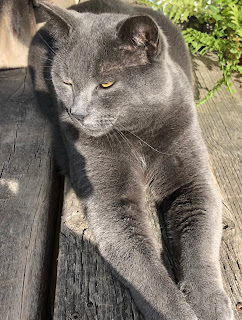
I have a part lab, part pit-bull, black dog, and a short-haired, domestic grey cat. 

The dog is quite strong and could kill the cat who’s also rather strong, but still much smaller. In fact, when the two first became housemates, I was quite worried. However today, as I watch the dog, watching the cat calmly washing himself after eating his lunch, I’m assured that there is peace in our home. I stroke the dog and commend him on his manners. He cuddles against me with gratitude. The cat, done with his toiletries, tail high, marches off for his spot in the sunshine while the dog now heads to the cat dish, hoping for leftovers.

Mere might does not determine power. Why is there peace between my pet rivals? Why don’t I have to worry about the dog and cat having a war? They’ve learned to respect each other, even as I respect them. True, the dog could scare the cat away and eat all its food, rather than just licking up the leftovers. The dog could harm the cat just because he could. The cat knows this. I know this. The dog knows this. But what point is there in being a bully? 

I don’t know what the dog is really thinking, but he seems to prefer love and respect from me and sometimes even tries to pay that forward towards the cat. (The cat, however, prefers a cooler distance.)  

Like my dog, no one seems to know what Putin is really thinking. But if my dog and my cat can respect each other’s boundaries and live together in one house, why can’t Russia respect Ukraine?


Why shut down Memorial?

So sad and disappointing to find out that the human rights organization, Memorial, is now an illegal entity in Russia. Why? Supposedly, Memorial has received foreign agent status after receiving funding from abroad. Technically, the NGO is supposed to acknowledge this funding on every web page, instead of just on the home page. Memorial also received internal funding, in tiny amounts, by family members oppressed during the Stalin years. 

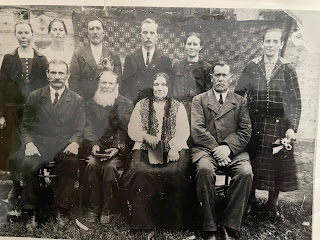
Family members affected by Stalin. Grandparents far right. 

It’s like Putin and his cronies have decided that my grandparents, whose stories I only discovered after the collapse of the USSR, never died because of Stalin’s liquidation of the kulaks. It’s like Putin saying that I have no right to know why my mom became orphaned at the age of 12 out in Yaya, Siberia. It’s like saying my grandfather was not wrongly accused for treason under Article 58 and shot during the 1937/8 Great Terror. It’s like the Russian present is afraid of its Soviet past.  Why would Putin deny his country’s atrocities? Because he wants his countrymen to be nostalgic for the good old days as a communist powerhouse. He wants to re-write history, but why? So he can affect the future?

Germany has accepted its dark Nazi past with numerous monuments, memorials and most importantly, education of the young. True, it took a full generation for the silence about Nazi atrocities to be broken and for the guilt to be admitted. But now we can look at Germany as a role model of how to reconcile the wrongs of the past and create a better present.

Here in Canada we have declared a national holiday on September 30th, as Truth and Reconciliation Day. It’s a tiny step  . . . as is renaming schools, streets and removing colonial oppressor monuments. We here have our own horrendous past with indignities perpetrated through the residential schools. Our racism is still alive and well, as our jails and our poor neighbourhoods can attest, but we are acknowledging its existence. Secrets lose their power in the light. 

Why is Putin silencing Memorial? Why is he so afraid of the truth? Memorial or not, inter-generational trauma is real. We see it on the streets of my city where I grew up seeing homeless drunks and being told that it was their race that was the problem not us—the colonizers. 

My family members. . . grandparents, mother, aunts and uncles, were victims of Stalin’s atrocities. Putin can silence Memorial but he can’t silence our stories. We have to tell them. It’s too bad the year has to end on such an ominous note. May the new year bring positive change. Happy 2022 to us all!


Recent Posts

Writer's News

I’m darn happy to share a bit of my writerly journey on a podcast, ‘ A Writer’s Life ’ hosted by the gracious and fabulous host, Heige Boehm...