Showing posts with label Second World War. Show all posts

Waltraut or Waltraud?

Finished reading Waltraud by Tammy Borden from my summer reading list, just before fall is set to officially begin. What an amazing book and I’m so grateful to have read it. The author tells the life story of her mother, born in 1927 in the Braunschweig area of Germany. 

Told in first person, it follows Waltraud from BDM days through the war, the confusing time after the war, until her immigration to Wisconsin in the USA.  I picked up the book because of the similar-sounding titles … my Waltraut vs. Tammy Borden’s Waltraud. My book is a novel for middle-graders and stays solely in the voice of an eleven-year-old Canadian girl while Waltraud’s voice moves from young child, to young woman.

It’s very well written and carries an emotional wallop, revealing complicated family relationships that were exasperated by war.  The author does an amazing job of stepping into her mother's world, in a succinct, yet compelling voice.  

I needed five middle grade and YA novels to depict my mother’s journey from 11-year-old Ukrainian kulak to being the mother of an 11 year-old North American girl.  Borden's one book covers decades of her mother's early life. Our protagonists share some similarities (one born in Soviet Ukraine 1919 and the other in Germany in 1927) with both stories being told in first person and written by their daughters. An interesting study in itself. 

I'm delighted to put Waltraud next to Waltraut. Whether it's Waltraut with a t or Waltraud with a d, both spellings mean 'strong' and each girl has a compelling story to share. Read them both!  


Wild Children

My mom had it tough as the Second World War wound down on the eastern front. I explore the failed winter exodus from East Prussia in Crow Stone … my YA release from Ronsdale Press, from back in 2022. Of the three sisters, fictionalized in the novel with the names of Katya, Sofie and Marthe, only Katya (inspired by my mom) is taken into the Soviet Union as a forced labourer. She went through some difficult times in the open pit mines of the Urals near Chelyabinsk. 

But what happened to her two younger sisters? I understood little about their experiences. Things were just too terrible to remember, they’d tell me. Let the past be forgotten, they’d say.  I knew rape and starvation were common under the Soviet occupation. I knew they weren’t allowed to leave the former East Prussia, renamed Kaliningrad, until 1948. I knew that others in my immigrant church community had similar experiences … but no one would talk about it.


So now I’m reading The Wolf Children of the Eastern Front, Alone and Forgotten, by Sonya Winterberg with Kerstin Lieff. It’s a heart-wrenching testimony of the horrors that lost children experienced in those stark years after the war. Unlike the dates in history books … the end of war doesn’t end the suffering. 

As a curious side note, the introduction to this book is by John Kay, the lead singer of the Canadian rock band called Steppenwolf. Born in Tilsit, East Prussia (now Sovetsk, Kaliningrad) in 1944, he narrowly escaped a similar fate that 20,000 young East Prussian children experienced. John Kay (born Joachim Fritz Krauledat) ended up in Canada in 1958 and went on to create memorable hits like “Born to be Wild.”  

Many children scavenged like wild animals in the desolate, bombed-out East Prussian countryside. My two aunts, fostering a lost toddler, and my teenaged cousins no doubt would have crossed paths with the orphans as they foraged for food trying to avoid Soviet revenge near the Lithuanian border. 


Rest in Peace ... Live in Peace

The story of Crow Stone … out in just a few days … begins on November 11th, 1944. Here’s the opening paragraph.

November 11. Today is Albert’s twenty-fourth birthday and he’s coming home to celebrate. Well not home, home, but what’s become home—Königsberg here in East Prussia. I’m meeting him at the train station, the same station where we arrived when we were homeless children—kulak orphans. Will I even recognize Albert? The men all looks the same in their grey field uniforms.

His brief visit will be the last time he gets to be with his family. Inspired by my mom’s real brother, August, he soon disappears into the quagmire of a Soviet Union prisoner of war camp.


Two months later on a Red Cross/Crescent postcard, dated January 17, 1945, he writes, ‘Things are going well so far, wishing the same for you. Hope we can soon reunite in our homeland.’ Well, there was no homecoming, no home to return to, and no future. 

This Remembrance Day I want to remember that war kills. It kills the enemy, the hero, the child, the old woman, and the family dog. War doesn’t focus on a uniform or on an age.


Solzhenitsyn, Public Domain


In Prussian Nights, a narrative poem composed by Solzhenitsyn and committed to memory while he was in the Gulag after being accused of empathizing with the enemy, he remembers war.

Some soldiers have gathered round

          A pram that’s been abandoned,

Blue,

Lace trimmings, too:

’Look, a little ‘un.

Still, he’s a German!

He’ll grow and put a helmet on.

Deal with him now, d’you think?

The order from Supreme Command

Is Blood for Blood!    (p. 67. Prussian Nights, translated by Robert Conquest)


Rest in Peace, Uncle A. Let me never take this living in peace for granted. 


Prisoners of History

RIAN_archive_129359_
German_prisoners-of-war_1944
in_Moscow.jpg

Like most of the world, I’ve been following the Ukraine War with great interest. This past week, there were headlines about the first Russian prisoner of war, charged with war crimes. A 21-year-old Russian has been found guilty of shooting a 62-year-old man on a bicycle. He was ordered to shoot and he did. The widow of the civilian feels sorry for the young soldier, now sentenced to life in prison, but can’t forgive him. Of course not. Forgiveness and healing take time. Will we ever forgive Putin for starting this mess?  

Besides perpetrators of specific war crimes, there are regular prisoners of war. The Ukrainian survivors of the valiant Mariupol siege are now prisoners of war. Supposedly up to 1700 Ukrainian soldiers are in Russian hands. Not an enviable fate. Being formally registered by the Red Cross so that humane treatment can be guaranteed under the Geneva Convention, doesn’t seem all that reassuring.

Bundesarchiv_Bild_101I-187-0203-06A,_
Russland,_1941
Russische_Kriegsgefangene.jpg

During the Second World War, because the USSR had not signed onto the 1929 Geneva Convention, the Nazis did not feel obligated to follow it.  Soviet soldiers captured by Nazis were thus doomed to death by starvation or complications from disease. (And they’d thought life in the Soviet Union with Stalin had been tough.) Two out of every 3 Soviet prisoners died without any ammunition wasted on them.


Public Domain, Russian prisoners of war near
Sumy, April, 2022


Revenge was inevitable and when Germany finally capitulated, people like my dad—once a pilot for the Luftwaffe, later a member of the Military Police on the East Front—ended up in terrible camps with equally high mortality rates. And to make-up perhaps, for all those forced Ostarbeiter, people like my mom—who’d never been in the military, or any Nazi groups, a young woman, forced to spend the war years in a munitions’ factory—slaved like a workhorse in open pit mines of the Urals. 

And now with social media and instant news, there's so much more propaganda regarding treatment of war criminals I can barely believe that the news headlines today are about current events. How can this all be happening again? 


On Mom's Trail


(This is a copy of an article I prepared for SGGEE (Society for German Genealogy  in Eastern Europe) It can be found in its most recent journal, available to members only. (Vol. 24 No.1  2022 March). 
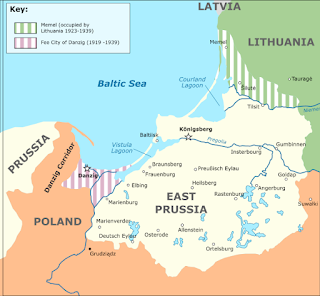
creative commons
It’s long been an ambition of mine to physically retrace my Volhynian-born mother’s footsteps. With Don Miller’s guidance, I started at the beginning, in Federowka, 35 kilometers northwest of Zhitomir. That’s where the storks dropped off Else Ristau back in 1919. On that roots tour, in 2004, I visited Zhitomir’s secret police files and perused documents which convicted my grandfather—former windmill owner, Eduard Ristau—as a class one kulak, guilty of counter-terrorism.  I viewed the ditch where they dumped his body in the fall of 1937 during the Great Terror and even looked for happier times in nearby Pulin, where Mom was allowed a sip of her father’s dark and bitter beer. Most dear to me were the granite remnants of the Ristau windmill discovered with the help of Helene Nickel, an older woman in Federowka. I tucked a piece of its red granite base into my mom’s pocket when she was buried later in 2011.   
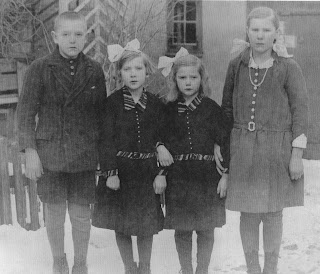
Kulak orphans in Kreuzburg


That 2004 trip became an important turning point for my sense of self.  Growing up here in Canada, without much of a history—my mom having only a confused and limited point of view of what she’d been through—had left me feeling untethered, detached and without a true identity. With the help of SGGEE, and much reading, I now have a rich inheritance and a much stronger appreciation of my place in this chaotic world affected by war, social unrest, and now, even a pandemic.  How rich we are when we discover our past. 

My mom survived her Siberian exile as the child of a kulak and in 1932 ended up with Ristau relatives in Kreuzburg, East Prussia (now Slavskoye, twenty kilometers south of the present city of Kaliningrad). In the fall of 2019, I cycled through these East Prussia parts of my mom’s life. 

The former Ostpreussen (East Prussia) no longer exists as a political entity. Germany’s easternmost province is now divided amongst Russia, Poland and Lithuania and while Lithuania and Poland have prospered in the thirty years since the fall of the Soviet Union, the tiny Kaliningrad Oblast continues to be a rather forlorn part of eastern Europe—a place for Putin to test his missiles within shooting range of the rest of Europe. 

The guided adventure began in Riga, Latvia and we alternatively biked and drove down to Klaipeda, Lithuania. Klaipeda, once the German city Memel, sits right on the Baltic. There we admired a statue of Ännchen von Tharau. (Germans might be familiar with the famous folksong about her.)  Back in the 1930s, her statue had incensed Hitler when he realized she had her back to him while he orated a victory speech from a balcony overlooking the public square. 

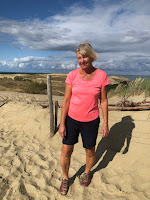
From Klaipeda, we took a ferry across to the Curonian Spit—a scenic ninety-eight-kilometer long strip of ecologically-fragile land, a Unesco World Heritage area, divided between Lithuania and Russia. On the Spit, we encountered huge drifting sand dunes, wild boar, and migrating birds. It was during my 2004 trip to Ukraine with Don Miller that I learned to appreciate birds . . . especially the storks and the cuckoos. Our East Europeans ancestors were closely connected to nature and this is reflected in their culture—including their songs, poems and memories.

Our small group (there were six of us) stayed overnight in Nida (Nidden), a resort town made famous by Thomas Mann who spent several summers there, and established a writing colony, after receiving the Nobel Prize for his novel Buddenbrooks in 1929. Later, the Nazis confiscated his place and turned it into a convalescent home for recovering Air Force officers. My father, himself at one point an injured Luftwaffe officer, was never amongst the privileged elite . . . a good thing, I’d say.

From Nida, we continued to the Russian half of the Spit. While there was only a modest entry point, it felt intimating entering Russia on a bike. The border guards took their job seriously with fearsome-looking guns and barking dogs. I was grateful for our multi-lingual guide who got us safely across and I’m sure he was grateful, too.

The difference between Lithuania and Russia on that Curonian Spit was felt as soon as we used the park washrooms. I preferred the natural setting of the bush (even with the stinging nettle or possibility of wild boar), to the filth of the offered outhouses. And yes, we did spot wild boar, along the road as we cycled. 

In spite of the dirty washrooms, this part of Russia had an inviting rustic charm. We stopped in Rybachy (formerly Rositten), which had been a renowned German migratory bird research station and is still used by Russian naturalists. Climbing the sand dunes was an amazing—and exhausting—off-road adventure. Because of the delicate nature of the dunes, we needed to stay on marked paths. Entire villages have been buried by the drifting sand dunes over past centuries. Good luck finding clues to ancestors in those villages. 

Our first night in the Kaliningrad Oblast was in the former spa town of Cranz (now Zelonogradsk). This area along the Baltic is also known as the Amber Coast—and yes, I hunted for amber—unsuccessfully. Later I bought some at one of the ubiquitous kiosks selling very affordable amber jewelry. 

Aside from natural beauty, the German influence is still strongly reflected in the architecture of Zelonogradsk. While Russian corruption or confusion has left some of the modern beachfront hotels indefinitely unfinished, old German villas offer a laid-back ambience of a past era. Trains in the 1930s had regular-scheduled, heavily-used routes for the East Prussians to enjoy the Baltic Sea breezes. 

It’s nearby along this same coast, by the Palmicken amber mines (now Yantarny) that Nazis forced thousands of Jews into the icy Baltic back in January, 1945. So much history, so much loss, along these scenic shores. Unlike visiting Ukraine, where a woman tried to spit in my German face, I found more awareness here of the positive aspects of German influence. 


On to Kaliningrad, the capital city of the Kaliningrad Oblast. Known as Königsberg since 1255, and the birthplace of Immanuel Kant, the city was decimated during the final months of the Second World War. My mom had shared tales of using the city tram and of window shopping in the once prosperous city. My personal obsession here was to eat Königsberger Klopse in a local restaurant. 

There’s little in Kaliningrad to remind a German tourist of the past. This was Stalin’s intent and he’s succeeded. However, The Dom next to Kant’s memorial, has recently been rebuilt. Even the Russians. . . transported here to replace the exiled Germans . . .  admit that Königsberg was once beautiful and embrace its complicated history. I felt overwhelmed with a sense of loss.  The brutalist House of the Soviets, (behind me in the photo), was built in the seventies to replace the war-damaged Königsberg Castle. It’s never been used or even finished. Back home, when I shared my trip with an older German woman who’d survived the devastation of East Prussia, she reminisced about how the chestnut trees began to bloom in January, 1945 because of the heat from the fighting. Now the downtown core was mostly concrete and traffic.

I’d prearranged a side trip while staying in Kaliningrad to visit the former Kreuzburg, my mom’s hometown during the 1930s. Now called Slavskoye, it’s about 20 kilometers south of the city.  We drove, rather than biked, to this town and upon retrospect, that was a bad choice. The traffic jam, leaving Kaliningrad city, was terrible. Did everyone have a dacha out in the countryside? Our Belorussian driver, Igor, slowly inched past the modern sports stadium built for the 2018 World Cup.  He didn’t hesitate to use his horn or even boulevards as necessary. Finally, we were out. 

Unlike the city which was rebuilt with the ugly Soviet-style concrete monoliths, rural areas of this oblast are marked by derelict ruins leftover from the German years. I was especially charmed by more of the majestic linden and chestnut trees lining the roads. Like the birds, trees and perennials tell stories of past generations. This was the East Prussia I had visualized. All that was missing were the Trakehner horses for which East Prussia was once famous. 

Similar to making family connections in Federowka back in Ukraine, I felt myself nervously anticipating what I’d find here in this hometown—this neglected time-warp of Europe—wedged between the past and the future. The Germans had all been forcibly expelled after the war and the area had been repopulated with unmoored people from the rest of the Soviet Union. A lot of the good, arable land still lies dormant—beautiful but wild. 

I was delighted to walk down the broken cobblestone main road of the former Kreuzburg and thrilled to later find the house where my mom found shelter with East Prussian relatives. Yes, the house my uncle had built in the 1930s was still standing. Earlier, I’d discussed its location with my one surviving cousin now living in BC.  “At the end of the road, in the ‘Schul-siedlung’ (school neighbourhood) with a well in the front,” she’d told me. We asked for help along the way and found it, just like she said. 

Second World War bullet holes still marred the house exterior, but on the whole, the house was lovingly looked after by an old man resettled from Kazakhstan who was proud to walk us through his beautiful garden. Time restraints, on account of the previous traffic jam, forced me to decline his offer for tea inside. His curious neighbour, her yard boasting a tree of ripe apples, was also curious about us. Wonderful people and I would never begrudge them my family’s former world.

Not far from the house stood the school my mom attended. The outside, still bullet-pocked and neglected, appeared to be used as an apartment with several residences. According to reports I’d read, by February, 1945, the Wehrmacht had sought shelter in the school while fighting off the Red Army. The village has an extensive graveyard for the fallen Soviets who died far away from their own homes here on what was once German soil.  Meanwhile, my mom’s younger brother, who disappeared during the last months of the war and ended in a Soviet camp, was never to have a marked grave. Such is war.

Our bike trip continued the next day and we cycled out of Russia into Poland. At one point, we cycled parallel to what was left of the Autobahn Hitler had started building for his Volkswagon. The Berlinka would have connected Königsberg to Berlin. Somewhere nearby would have been Stablach, a military establishment with a munitions’ factory. My mom worked there, and lived in its barracks throughout the war, cycling the eight kilometers back to Kreuzburg for visits. 

It didn’t us take long to reach the Polish border crossing at Mamonowa (the former Heiligenbeil) where we waited for hours as vehicles around us were taken apart. Dogs sniffed through everything. When it was finally our turn, our Canadian passports were greeted with a smile and a quick wave through.

In the winter months of early 1945, there was a different kind of slowdown on these roads. Back then, the snowy woods and pathways would have been jammed with military vehicles going one way, and mothers and children pulling all they could, the other way. Civilians tried to reach the ships waiting in harbours along the Baltic. They crossed over the icy, slushy Frisches Haff (Vistula Lagoon) from small towns like Frauenberg (now Frombork) to reach Pillau so they could board ships like the Wilhelm Gustlaff or the equally doomed, Goya or Steuben.  These ships offered them an escape from the Soviet tank armies, but not necessarily the Soviet Navy. More than fifteen thousand, mostly women and children, drowned in the icy Baltic in those early months of 1945.

It was misty, the day when I looked over the Vistula Lagoon . . . a brackish strait of water that in 1945 froze because of the extreme cold. It offered a welcome shortcut to the ships. I imagined the broken wagons stuck in ice as the low flying Soviet bombers strafed the desperate civilians. A poignant moment for me.  
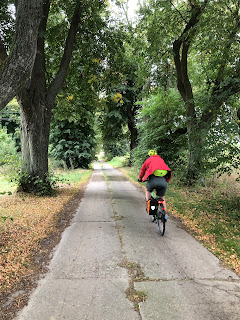
My mom and her sisters, however, never made it as far as the Vistula Lagoon. They were stopped by Red Army soldiers somewhere in the woods along the trails that I cycled. For my mom, it meant transport back into the Soviet Union of her childhood. It meant more than two years of forced labour in an open pit mine in the Urals. For her sisters, it meant working on a Soviet kolkhoz near Drobrovolsk (Pillkallen or Schloßberg) until 1949. As I cycled through the scenic beech tree woods, I had much time to ponder their loss of freedom, lots of time to imagine the bodies of the hastily buried under snow in the ditches along the way. Lots of time—especially when the cycling trail was uphill!

Cycling is a great way to appreciate a landscape and because I grew up with the echo of Ostpreussen in my ears, it felt a bit like going home. While we can’t travel now, we can research to make a future trip more meaningful. After all, genealogy and travel go together like good cousins.


When Gdańsk was Danzig

I’m reading a Second World War book structured through letters between two young cousins. Peter lives in rural Saskatchewan and Ulla lives in the city of Danzig (now known as Gdańsk). I love the contrast—along with the similarities—between the two children. What they share is the innocence of youth along with a common Mennonite culture. I’ve been reading a lot about Mennonites lately. It’s purely coincidence, but probably due to the many Mennonites that live here on the prairies and the many writers and readers amongst them. While my growing up experiences share many cultural aspects with the Mennonites, our family would never identify as such. Always on the outside looking in, that's me. 


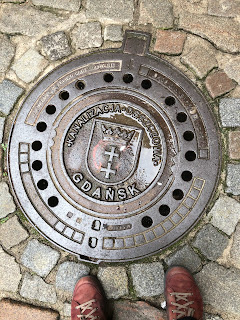
What caught my interest, specifically, about Dear Peter, Dear Ulla by BC author Barbara Nickel, was the German setting of Gdańsk (now a Polish city). Any time you visit a place, in person, revisiting it on paper makes for a stronger connection. I spent three days in Gdańsk at the end of my Baltic cycling trip and was enthralled with its history and beauty.
Neptune fountain (mentioned in Nickel's novel

Up until the visit, all I really knew of the city was its setting as the beginning of the end of Soviet communism. It was the Gdańsk shipyards where Lech Walęsa started the Solidarity movement in 1980 for which he received the Nobel Peace Prize in 1983.  It was a powerful experience to view his former shipyard office.
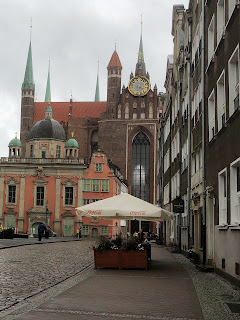
View of St, Marienkirche /St Mary's
mentioned in Nickel's novel

Now through Barbara Nickel’s book, centered around the 1939 Nazi invasion of Poland and the attack on the Polish Post Office, I’m learning more of the beautiful city’s brutal history. 

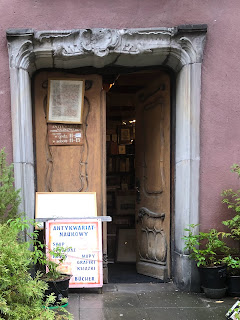
Gdańsk still is a beautiful city. The old city centre has been meticulously restored. It was a delight to wander down its pedestrian friendly streets, hunting for that perfect piece of amber jewelry, admiring restored buildings, and stepping through century-old doorways. What a statement of pride . . . to rebuild, to remember and to honour the history of a place and its people. Gdańsk is like a piece of amber. Unlike Kaliningrad (former Königsberg)—which under Soviet control after the war, chose to demolish the ruins—Gdańsk has rebuilt and remembered.

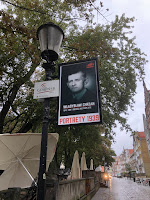
Portraits of Polish war heroes
lined the streets


Old doorway leading to old books
in the restored old city of Gdańsk


That’s why I love reading historical books. Fiction like Barbara Nickel’s YA novel, Dear Peter, Dear Ulla, also rebuilds and remembers. Like pieces of amber, books can also carry secrets of time. 


Discovering Schlesien

I'm a bit of a luddite when it comes to technology and yet it’s technology that has been one of my biggest supports throughout this pandemic and a bridge to new worlds. When I take my dog on our cold nightly walk down icy sidewalks in suburban Winnipeg, I need my tech connection. While Striker sniffs out the yellow snow and leaves his mark on the mountainous snowbanks, I listen to podcasts sharing travel tips, discussing novels or pondering history. 

I’m also using podcasts to improve my wobbly German language skills—grateful for this gift of fluency in another language—but quite aware that I need to use it or lose it. 

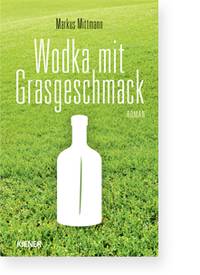
Which brings me to the latest German novel I just finished reading—Wodka mit Grasgeschmack by Markus Mittmann. The novel is about two adult brothers who travel with their parents back to the former Schlesien in today’s Poland. I first heard about this book on the podcast: Culture to Go where the topics focus on refugees from the Second World War.  

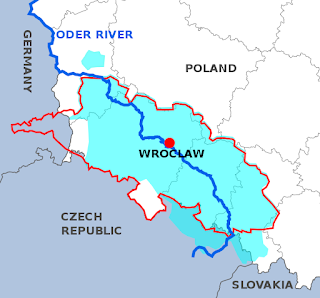
Lommes-CC By-SA 4.0


The Schlesien area was decimated during the final months of the Second World War after Hitler declared Breslau a ‘fortress’ city. All the Germans had to leave after the war and Breslau became Wroclaw, Poland. As Wroclaw, the city has thrived and become a hub of culture. In fact, Wroclaw received the distinguished title of UNESCO City of Literature in 2019. It’s considered one of the best and smartest cities of the world.

Mittmann’s book was also smart—and funny—and so relatable. A family squished into a lemon-yellow VW beetle driving into the past. Isn’t that a great set-up for a novel? I loved it. And I love all the episodes on Culture to Go where I’m connecting, learning and validating my own family stories. The luddite in me has to admit, technology is amazing with so much history only a podcast away. 


About Books, History and Geography

When cycling the Curonian Spit a couple of years ago, I was overwhelmed with its beauty. An ecologically-sensitive area, protected by UNESCO, the Spit’s 98 kilometers long, covered in shifting sand dunes and home to many migrating birds. The Spit, a finger of land extending between the Baltic Sea and the Curonian Lagoon, is politically divided between Lithuania and Russia, and steeped in history. 

I’d been eager to visit Thomas Mann’s family beach house. The pretty blue cottage has been well maintained over the years. Located in Nida, on the Lithuanian side, it’s shifted, like the sand, from summer family retreat, to convalescent centre for Goring’s elite Luftwaffe officers, to a writing centre/museum for current visitors. 

Cycling break in Preila
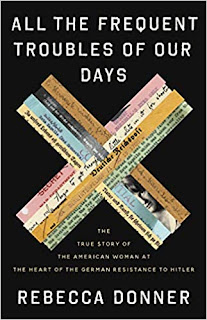
While reading All the Frequent Troubles of Our Days, the completely engrossing biography by Rebecca Donner about Mildred Harneck and the Red Orchestra resistance movement during the Nazi years, I discovered another connection to the area. It’s in tiny Preila, also on the Lithuanian side of Spit. We’d stopped for lunch in Preila during our cycling trip. According to Donner’s book, Preila was the last place that Mildred and her husband Arvid experienced freedom.


On sand dune near Preila
She was there on September 5, 1942, exactly the same time of year, I visited, almost 80 years later.  The natural beauty of the area hasn’t changed much even after 8 decades. Donner describes how Mildred and Arvid would have embraced the scene. She writes, “The Baltic Sea is cold and majestic, its color a rich purple so dark it is nearly black.”  

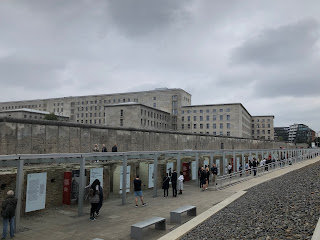
The couple, now fleeing for their lives, planned to escape Hitler’s grasp via boat for Sweden the next morning. Instead, they were greeted by the Gestapo.Taken back to Berlin, to the cellar of Gestapo headquarters at Prinz-Albrecht Strasse 8, they were tortured, tried and executed in quick order. Arvid hung in December and Mildred was decapitated in February, 1943. I toured the Gestapo headquarters' site, now a memorial and outdoor museum, after I ended my bike tour, unwittingly following in Mildred's footsteps. 

Former Gestapo headquarters in Berlin

Mildred’s story is all the more engrossing because she was an American and because the consequences of her heroic efforts were smudged away. Why? Because being anti-fascist in Berlin during those years meant being pro-Soviet. Once the Nazis were defeated, the Americans considered anyone pro-Soviet an enemy. Former Nazis were treated better by the western media than pro Communists during the Cold War era. 

February is a good month to remember brave women like Sophie Scholl, Mildred Harnack (and many others, shared via photographs from Gestapo files in the Donner book), who died that February, 1943.  It was a month when the colour red was of blood not of hearts, when it was hate, not love, that seeped into everything. Sophie and Mildred deserve our best efforts to never take freedom and peace for granted. Could I die for a cause? I’m grateful not to be tested. 

All the Frequent Troubles of our Days, a gripping biography written in an engaging, accessible style with short chapters and many photographs. I highly recommend it to readers interested in World War Two history.


Growing Up in the Shadow of War


Remembrance Day. For me, war has never been about ceremony or about monuments. For me, war has been about two broken people—my parents—and all the baggage they carried in spite of immigrating to this country to start over. 

I was cleaning out some ‘stuff’ the other day. What might look like a box containing an old airplane model to others, is a poignant reminder of my dad and his years in the Wehrmacht.


In 1936, age 18, he joined the Luftwaffe It gave him a smart-looking uniform, stability and status. When the war started he flew, among other planes, the Junker 52. According to the description on the model box, the plane was nicknamed “Tante Ju” or “Aunt Ju.”  It was a transport plane and when my dad crashed in 1941, he had 17 paratroopers on board. All died while he, as pilot, was the lone survivor, spending more than a year in the hospital. The crazy thing is that I only learned about this during the pandemic when my brother and I went for a walk. My brother said Dad always felt responsible for those 17 deaths on his plane. 

You see, war talk was boy talk and so I never heard Dad’s war stories. While my brother and our dad focused on building model airplanes, I was learning domestic stuff like cooking and cleaning. The stories I heard were about the dangers of promiscuity, of unwanted babies, of disease-bearing fleas and bedbugs. I learned about recycling, reducing and reusing. 

Growing up in the shadow of the war was not glamourous or monumental. It was shameful and quiet. As someone (Churchill?) so aptly noted, history is written by the victors. 


Baltiysk, once Pillau


Pillau 1945, Bundesarchiv_Bild_146-1989-033-33

One of the Baltic ports that I didn't get a chance to visit back in 2019 was Baltiysk in the Kaliningrad Oblast. It's situated on a narrow spit, separated from the mainland by the Vistula Lagoon.

To visit Baltiysk (Russia’s western-most town, population ~32,000) requires a pass from the FSB (Russia’s Federal Security Service), so I didn’t see it, but I sure heard it.  As we cycled along the Baltic Coast, past Yantarny (former Palmicken) with its amber mine, we could hear nearby military hardware exploding and could feel it rumble the earth under our tires. 


Leftovers from German times near the former Fischhausen

We got to within about ten kilometers of the militarized area, changing direction again when we got to Primorsk (the former Fischhausen). Hearing the explosions from such a distance was the closest I’ve been to such lethal weaponry and it made me shudder with a vague realization of war’s power.  


Ruins near Primorsk

Once known as Pillau, the Baltiysk port was renamed after the Nazi defeat. Originally a fishing village, it has a storied and much-conquered past. Swedes, Lithuanians, Teutonic Knights and pre- Soviet Russians all left their mark on the town. Located on the Vistula Spit, the Germans used it primarily as a harbour for passenger ships, (although it did have a sub building industry) with commercial shipping routed on towards the improved and expanded Königsberg (Kaliningrad) docks.

Back in the final months of the Second World War, Pillau was the coveted goal of many an East Prussian . . . people like my mom. Until the second half of January, 1945, civilians had been told to stay put and believe in the ‘final victory.’  Like me, she never got to see Pillau, now Baltiysk, either.  The Vistula Lagoon was mostly frozen in the winter of 1945. In the bottom photo, a fellow cyclist looks over the Vistula Lagoon towards Baltiysk.  This lagoon, shrouded in fog, was the slippery path forward for the desperate women and children. Many a horse and wagon crashed through the ice as the Soviet bombers strafed them from above.

Of course, I had to explore this further by writing another book. Coming out next spring. More details available soon.


Silent Mysteries

I grew up in a house with different kinds of silence. I won’t call them all secrets, because some were born of ignorance and not deliberate. My mom’s family past, for example, belonged to the former. She didn’t know what happened to her dad. She didn’t understand the politics of communism and then later, Nazism. She was an uneducated pawn, shuffled around for authoritarian agendas. First as a kulak child, later as a munitions worker, still later as a forced labourer. I couldn’t judge her as guilty, merely naïve.

My dad’s silences, however, were deliberate secrets. Some of these were based in guilt, others based in shame. The difference, you ask? In its simplest form, guilt is based on others’ judgment of you, while shame is a self-judgment. My dog might feel guilty because I caught him stealing the cat’s food, but he has no sense of shame. I might tell him he’s a bad dog, but all he wants is my approval. In fact, his only goal is to next time not be caught in the act. 

German soldiers talking to French women 
 Bundesarchiv, Bild 101I-129-0480-25 / Boesig, Heinz / CC-BY-SA

My dad voluntarily joined the Luftwaffe when he was 18 in 1936. He participated in the invasion of France and once shared how he drank cognac in Cognac, France. That’s where I—the know-it-all, Canadian-born daughter—judged him as a guilty perpetrator of war. I didn’t want to hear more of his war exploits. So he kept quiet around me.

But he had other secrets. One included a failed first marriage and dead children. That was a silence I wish he’d broken, and a secret I wish he’d shared. It took a bit of sleuthing on my part, but now I can only pity him when I finally learned the details about that secret. That was his private shame. It’s a book I’ve been working on. Complicated . . . filled with guilt and with shame. There’s nothing like a mystery to keep me exploring and writing family history. 


Children of War


I have no photographs of my dad’s first marriage. The only photos I have of that 1940 union is of a gravestone for Wilhelm, who died as an infant, and another one where my dad holds a toddler. Two young boys. And my dad was their father? How could this be? 

I only got to see this photo once when I was growing up, while hiding under the dining room table. My hiding place was discovered and the album grabbed away from me. (The same thing happened when I viewed a medical book with nudity in it). It was enough to ignite my imagination. 


Who were these little boys? Why was a photo of a baby’s gravestone in the family photo album? No one would tell me. It was just one of those secrets that kids weren’t supposed to know and you know how it is about secrets . . .. It’s a challenge I’ve embraced and explore by writing my novels. My current work-in-progress focuses on my dad’s broken first marriage.


The Nazis were all about strong families, with programs to keep mothers pregnant and in the home. It’s ironic that after the war there was a higher than normal divorce rate and my dad’s first marriage was one of the casualties. He married Lydia in 1940 when mass-weddings were popular. Armistice Day November 11th—was a popular choice and each couple received a copy of Mein Kampf as a wedding gift. It was required to prove Aryan-purity and acquire an Ahnenpass —proving Aryan heritage

—before getting the marriage license. The Nazis wanted their soldiers to impregnate their Aryan women and produce new soldiers for the Third Reich. 


My dad and his first wife created two potential soldiers. Unfortunately, with the ultimate failure of Hitler’s ambitions, the two little boys died in the final months of the war. My half-brothers never got to grow up in Hitler’s planned utopia. No doubt, their deaths helped in the dissolution of my dad’s first marriage. Another factor was his five-year-long silence. As a prisoner of war, his mailings never made it to his wife and she gave up on him. Found a new lover amongst the Allies who occupied Germany.  My dad returned from USSR in late 1949, and in 1951 the marriage was officially over. 


A simple story that was never shared with me. I had to be a sleuth and figure it out on my own. Now it’s fodder for my writing brain. German readers might consider Heimkehr, 1948 edited by Annette Kaminsky where a collection of essays describes the broken marriages faced by returning prisoners of war. 


Heligoland's April 18th Anniversary

Lange Anne


A highlight of my time in Schleswig-Holstein last September was a two-hour cruise to the North Sea island of Heligoland. It’s had a variety of overseers . . . Danish, British, and Germans and was of strategic importance to the Nazis. Now, as a tax-free haven, it survives on tourists like me who come via small ships. That's the ship called 'Funny Girl' behind me. What is it with Germans and their love of English names?


During the four-hour guided tour, I was able to appreciate a bit of the history and a lot of the natural beauty as we climbed 184 (yes, I counted!) steps up from the rocky pier. There are no cars or bikes allowed on the island (except for electric service vehicles) and this added to its peaceful ambience. 

One grave for many
The island was far from peaceful during the Second World War. Soviet prisoners of war were used to build the extensive underground bunker system. I never had enough time to do the underground tour, but the above-ground tour had many ruins related to the war years. 


Northern Gannets breed here
Soccer field on east side of island
The island was almost crushed on April 18th,1945 with bombing by almost one thousand British aircraft. After the bombings, scattered bones from old graves were gathered into one.  For two years after that the island was left empty and used for military practice.  

Then, again on April 18th, in 1947, one of the biggest non-nuclear explosions—The British Bang or Big Bang—occurred. The Allies had gathered up most of the remaining ammunition stored on the island and blew it up. A huge crater still remains and it's forever changed the shape of the rocky island. 

In 1952, the surviving locals were allowed to return and rebuild their island village. We hiked along winding paths past cottage homes with beautiful gardens. Our tour guide was a most affable fellow, obviously proud of his home.  Heligoland is a nature refuge where birds stop off during migration and northern gannets breed amongst the ruins of war. Amazing how life begins anew over and over. How I'd love to go back and stay longer. A true treasure.


World War Two Still Relevant

I’ve been listening to the Canada Reads discussion on CBC this week…finding some mundane chore to keep my hands busy as my mind follows along. Usually, I spend my mornings word crunching my own WIP. I haven’t yet read any (!) of this year’s shortlist…but I have every intention to read them all because each one sounds compelling. The conversation, as the panelists defended their choices, kept me sweeping and washing the kitchen floor. I even made cookies one morning…something I never do…just to keep my ear glued to the radio. (Don’t ask about my other options…the CBC has always been relegated to the kitchen.)

I’m delighted, although surprised, that By Chance Alone (Max Eisen) won. After all, there’s been so much written about the Second World War. Haven’t we heard enough? No, apparently the topic still needs attention. Now, just because I’ve been obsessed with this topic since my own youth, I didn’t assume that others would still find it so relevant. The participants of that hellish time are fading fast. Now is the time to listen to those personal experiences. 

For my personal journey, the focus in not on the victims, but on the perpetrators. Both my parents were active in the war…as Germans. For me, to understand the enemy, is to understand my family…is to understand myself. That’s why I’m saving my pennies and my nickels for this summer’s adventure overseas. I need to understand how my father, at eighteen, joined the Luftwaffe. I need to understand how my mother walked through the East Prussian winter to escape the Soviets. I need to understand why they left that bombed out world to start again in this country…a country that has itself been ravished by the violent usurpers who now govern.

So I have to read By Chance Alone and I have to read the others books. They’re relevant to my life and to the lives of my children who can’t help but take for granted all this good stuff…this free thinking and free moving society. The Canada Reads book discussion gives me hope. We aren’t all just navigating traffic around shopping malls. We're trying to understand why any of this matters.

Recent Posts

Russians from Germany featured in New Fiction

English translation published by CMU Press I read two recently published works of fiction about Germans from Russia. Both authors had signin...