(This is a copy of an article I prepared for
SGGEE (Society for German Genealogy in Eastern Europe) It can be found in its most recent journal, available to members only. (Vol. 24 No.1 2022 March).
 |
| creative commons |
It’s long been an ambition of mine to physically retrace my
Volhynian-born mother’s footsteps. With
Don Miller’s guidance, I started at the beginning, in
Federowka, 35 kilometers northwest of
Zhitomir. That’s where the storks dropped off Else Ristau back in 1919. On that roots tour, in 2004, I visited Zhitomir’s secret police files and perused documents which convicted my grandfather—former windmill owner, Eduard Ristau—as a class one kulak, guilty of counter-terrorism. I viewed the ditch where they dumped his body in the fall of 1937 during the Great Terror and even looked for happier times in nearby Pulin, where Mom was allowed a sip of her father’s dark and bitter beer. Most dear to me were the granite remnants of the Ristau windmill discovered with the help of Helene Nickel, an older woman in Federowka. I tucked a piece of its red granite base into my mom’s pocket when she was buried later in 2011.
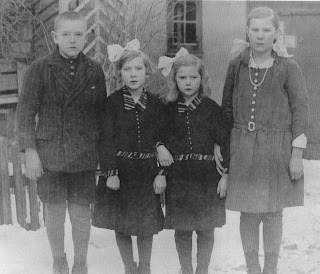 |
| Kulak orphans in Kreuzburg |
That 2004 trip became an important turning point for my sense of self. Growing up here in Canada, without much of a history—my mom having only a confused and limited point of view of what she’d been through—had left me feeling untethered, detached and without a true identity. With the help of SGGEE, and much reading, I now have a rich inheritance and a much stronger appreciation of my place in this chaotic world affected by war, social unrest, and now, even a pandemic. How rich we are when we discover our past.
My mom survived her Siberian exile as the child of a kulak and in 1932 ended up with Ristau relatives in Kreuzburg, East Prussia (now Slavskoye, twenty kilometers south of the present city of Kaliningrad). In the fall of 2019, I cycled through these East Prussia parts of my mom’s life.
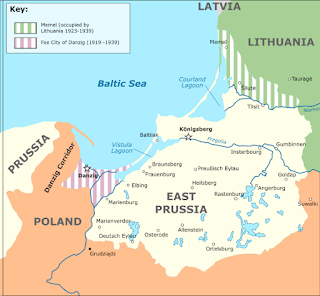
The former Ostpreussen (East Prussia) no longer exists as a political entity. Germany’s easternmost province is now divided amongst Russia, Poland and Lithuania and while Lithuania and Poland have prospered in the thirty years since the fall of the Soviet Union, the tiny Kaliningrad Oblast continues to be a rather forlorn part of eastern Europe—a place for Putin to test his missiles within shooting range of the rest of Europe.
The guided adventure began in Riga, Latvia and we alternatively biked and drove down to Klaipeda, Lithuania. Klaipeda, once the German city Memel, sits right on the Baltic. There we admired a statue of Ännchen von Tharau. (Germans might be familiar with the famous folksong about her.) Back in the 1930s, her statue had incensed Hitler when he realized she had her back to him while he orated a victory speech from a balcony overlooking the public square.
From Klaipeda, we took a ferry across to the Curonian Spit—a scenic ninety-eight-kilometer long strip of ecologically-fragile land, a Unesco World Heritage area, divided between Lithuania and Russia. On the Spit, we encountered huge drifting sand dunes, wild boar, and migrating birds. It was during my 2004 trip to Ukraine with Don Miller that I learned to appreciate birds . . . especially the storks and the cuckoos. Our East Europeans ancestors were closely connected to nature and this is reflected in their culture—including their songs, poems and memories.
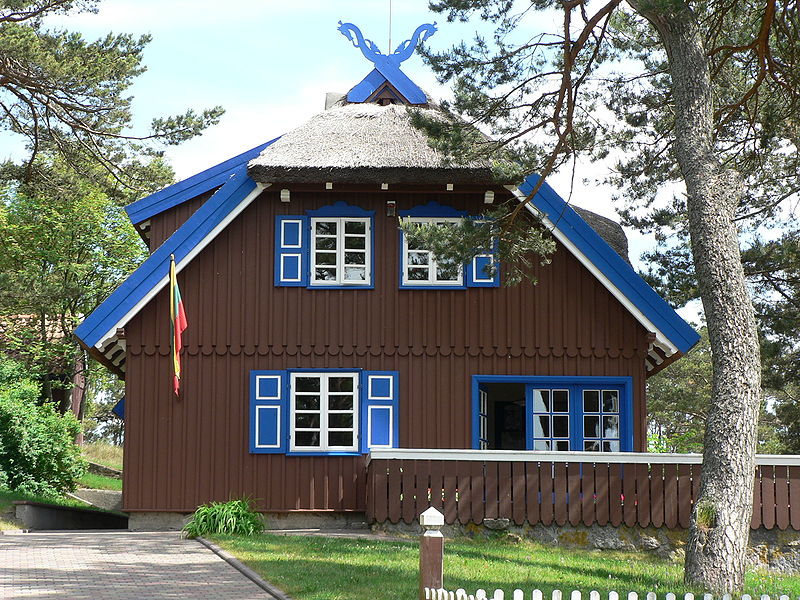
Our small group (there were six of us) stayed overnight in Nida (Nidden), a resort town made famous by Thomas Mann who spent several summers there, and established a writing colony, after receiving the Nobel Prize for his novel Buddenbrooks in 1929. Later, the Nazis confiscated his place and turned it into a convalescent home for recovering Air Force officers. My father, himself at one point an injured Luftwaffe officer, was never amongst the privileged elite . . . a good thing, I’d say.
From Nida, we continued to the Russian half of the Spit. While there was only a modest entry point, it felt intimating entering Russia on a bike. The border guards took their job seriously with fearsome-looking guns and barking dogs. I was grateful for our multi-lingual guide who got us safely across and I’m sure he was grateful, too.
The difference between Lithuania and Russia on that Curonian Spit was felt as soon as we used the park washrooms. I preferred the natural setting of the bush (even with the stinging nettle or possibility of wild boar), to the filth of the offered outhouses. And yes, we did spot wild boar, along the road as we cycled.
In spite of the dirty washrooms, this part of Russia had an inviting rustic charm. We stopped in Rybachy (formerly Rositten), which had been a renowned German migratory bird research station and is still used by Russian naturalists. Climbing the sand dunes was an amazing—and exhausting—off-road adventure. Because of the delicate nature of the dunes, we needed to stay on marked paths. Entire villages have been buried by the drifting sand dunes over past centuries. Good luck finding clues to ancestors in those villages.
Our first night in the Kaliningrad Oblast was in the former spa town of Cranz (now Zelonogradsk). This area along the Baltic is also known as the Amber Coast—and yes, I hunted for amber—unsuccessfully. Later I bought some at one of the ubiquitous kiosks selling very affordable amber jewelry.
Aside from natural beauty, the German influence is still strongly reflected in the architecture of Zelonogradsk. While Russian corruption or confusion has left some of the modern beachfront hotels indefinitely unfinished, old German villas offer a laid-back ambience of a past era. Trains in the 1930s had regular-scheduled, heavily-used routes for the East Prussians to enjoy the Baltic Sea breezes.
It’s nearby along this same coast, by the Palmicken amber mines (now Yantarny) that Nazis forced thousands of Jews into the icy Baltic back in January, 1945. So much history, so much loss, along these scenic shores. Unlike visiting Ukraine, where a woman tried to spit in my German face, I found more awareness here of the positive aspects of German influence.
On to Kaliningrad, the capital city of the Kaliningrad Oblast. Known as Königsberg since 1255, and the birthplace of Immanuel Kant, the city was decimated during the final months of the Second World War. My mom had shared tales of using the city tram and of window shopping in the once prosperous city. My personal obsession here was to eat
Königsberger Klopse in a local restaurant.
There’s little in Kaliningrad to remind a German tourist of the past. This was Stalin’s intent and he’s succeeded. However, The Dom next to Kant’s memorial, has recently been rebuilt. Even the Russians. . . transported here to replace the exiled Germans . . . admit that Königsberg was once beautiful and embrace its complicated history. I felt overwhelmed with a sense of loss. The brutalist House of the Soviets, (behind me in the photo), was built in the seventies to replace the war-damaged Königsberg Castle. It’s never been used or even finished. Back home, when I shared my trip with an older German woman who’d survived the devastation of East Prussia, she reminisced about how the chestnut trees began to bloom in January, 1945 because of the heat from the fighting. Now the downtown core was mostly concrete and traffic.
I’d prearranged a side trip while staying in Kaliningrad to visit the former Kreuzburg, my mom’s hometown during the 1930s. Now called Slavskoye, it’s about 20 kilometers south of the city. We drove, rather than biked, to this town and upon retrospect, that was a bad choice. The traffic jam, leaving Kaliningrad city, was terrible. Did everyone have a dacha out in the countryside? Our Belorussian driver, Igor, slowly inched past the modern sports stadium built for the 2018 World Cup. He didn’t hesitate to use his horn or even boulevards as necessary. Finally, we were out.
Unlike the city which was rebuilt with the ugly Soviet-style concrete monoliths, rural areas of this oblast are marked by derelict ruins leftover from the German years. I was especially charmed by more of the majestic linden and chestnut trees lining the roads. Like the birds, trees and perennials tell stories of past generations. This was the East Prussia I had visualized. All that was missing were the Trakehner horses for which East Prussia was once famous.
Similar to making family connections in Federowka back in Ukraine, I felt myself nervously anticipating what I’d find here in this hometown—this neglected time-warp of Europe—wedged between the past and the future. The Germans had all been forcibly expelled after the war and the area had been repopulated with unmoored people from the rest of the Soviet Union. A lot of the good, arable land still lies dormant—beautiful but wild.
I was delighted to walk down the broken cobblestone main road of the former Kreuzburg and thrilled to later find the house where my mom found shelter with East Prussian relatives. Yes, the house my uncle had built in the 1930s was still standing. Earlier, I’d discussed its location with my one surviving cousin now living in BC. “At the end of the road, in the ‘Schul-siedlung’ (school neighbourhood) with a well in the front,” she’d told me. We asked for help along the way and found it, just like she said.
Second World War bullet holes still marred the house exterior, but on the whole, the house was lovingly looked after by an old man resettled from Kazakhstan who was proud to walk us through his beautiful garden. Time restraints, on account of the previous traffic jam, forced me to decline his offer for tea inside. His curious neighbour, her yard boasting a tree of ripe apples, was also curious about us. Wonderful people and I would never begrudge them my family’s former world.
Not far from the house stood the school my mom attended. The outside, still bullet-pocked and neglected, appeared to be used as an apartment with several residences. According to reports I’d read, by February, 1945, the Wehrmacht had sought shelter in the school while fighting off the Red Army. The village has an extensive graveyard for the fallen Soviets who died far away from their own homes here on what was once German soil. Meanwhile, my mom’s younger brother, who disappeared during the last months of the war and ended in a Soviet camp, was never to have a marked grave. Such is war.
Our bike trip continued the next day and we cycled out of Russia into Poland. At one point, we cycled parallel to what was left of the Autobahn Hitler had started building for his Volkswagon. The Berlinka would have connected Königsberg to Berlin. Somewhere nearby would have been Stablach, a military establishment with a munitions’ factory. My mom worked there, and lived in its barracks throughout the war, cycling the eight kilometers back to Kreuzburg for visits.
It didn’t us take long to reach the Polish border crossing at Mamonowa (the former Heiligenbeil) where we waited for hours as vehicles around us were taken apart. Dogs sniffed through everything. When it was finally our turn, our Canadian passports were greeted with a smile and a quick wave through.
In the winter months of early 1945, there was a different kind of slowdown on these roads. Back then, the snowy woods and pathways would have been jammed with military vehicles going one way, and mothers and children pulling all they could, the other way. Civilians tried to reach the ships waiting in harbours along the Baltic. They crossed over the icy, slushy Frisches Haff (Vistula Lagoon) from small towns like Frauenberg (now Frombork) to reach Pillau so they could board ships like the Wilhelm Gustlaff or the equally doomed, Goya or Steuben. These ships offered them an escape from the Soviet tank armies, but not necessarily the Soviet Navy. More than fifteen thousand, mostly women and children, drowned in the icy Baltic in those early months of 1945.
It was misty, the day when I looked over the Vistula Lagoon . . . a brackish strait of water that in 1945 froze because of the extreme cold. It offered a welcome shortcut to the ships. I imagined the broken wagons stuck in ice as the low flying Soviet bombers strafed the desperate civilians. A poignant moment for me.
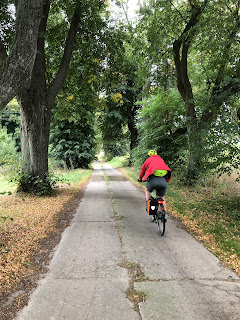
My mom and her sisters, however, never made it as far as the Vistula Lagoon. They were stopped by Red Army soldiers somewhere in the woods along the trails that I cycled. For my mom, it meant transport back into the Soviet Union of her childhood. It meant more than two years of forced labour in an open pit mine in the Urals. For her sisters, it meant working on a Soviet kolkhoz near Drobrovolsk (Pillkallen or Schloßberg) until 1949. As I cycled through the scenic beech tree woods, I had much time to ponder their loss of freedom, lots of time to imagine the bodies of the hastily buried under snow in the ditches along the way. Lots of time—especially when the cycling trail was uphill!
Cycling is a great way to appreciate a landscape and because I grew up with the echo of Ostpreussen in my ears, it felt a bit like going home. While we can’t travel now, we can research to make a future trip more meaningful. After all, genealogy and travel go together like good cousins.