Showing posts with label Christmas. Show all posts

Hedgehogs


Decorating our sentimental Christmas tree every year is like time travel. My current favourite ornament is this wooden hedgehog. I was thrilled when I spotted a real one during my 2019 cycling trip through former East Prussia, in the Kaliningrad region. 


Love how little, unexpected things can become the best souvenirs … treasures of the heart. 

Sadly, I learned from a recent news report that certain camouflaged Ukrainian tanks are now being nicknamed 'hedgehogs'.   War's impact is everywhere.  Read the story and view images here:

https://www.rferl.org/a/russia-ukraine-invasion-hedgehog-armor-fpv-drone-evolution-war/33614379.html


Ambivalence

Christmas seems mostly about nostalgia and it’s the traditions that help keep the magic going.  I admit that my Christmas flame is flickering on low this year. Family illnesses and other struggles have kept spirits down. But we have snow, we have darkness and we have cold. All necessary ingredients to let Christmas lights shine. 

I visited a Christkindlmarkt here in Winnipeg last weekend. Our local market is nothing like the European open-air events. It’s simply too cold for outdoor kiosks. This indoor market is basically a craft fair dressed up in Christmas colours. I went to get some holiday necessities … spices to make Glühwein and candles for my Advent centre piece.

I’m sure I’ll perk up as the season progresses. After all, the joy and gratitude that my immigrant friends exude might be contagious. An Iraqi family (Christian Kurds) I hope to share time with spent four years in a Turkish refugee camp. Their young children remind me of how wonderful it is to be in Canada … while my Ukrainian friends show me that home and family, electricity and water, peace not war, must never be assumed. Life itself is a reason to celebrate. 

Here I am, ambivalent about Christmas and yet it is the season of peace and goodwill. How dare I take it for granted?  Perhaps the scent of the Christmas tree will revive me.  Time to go tree-hunting! 

Just jotting down these thoughts has put some of Dickens’ Tiny Tim attitude into my season. “God bless Us, Every One!”


If Tables could Talk

December, 1953. This photo shows my extended family celebrating their first Christmas as newcomers to Canada. The women in the photo were born in Ukraine; my dad and Uncle #2 were born in Germany.

Dinner was around a maple table in a rented house in the Wolseley neighbourhood. Yes, there's the ubiquitous fowl … probably a turkey, but maybe a goose … centre stage. 

Because I write fiction, I won't identify these people (except my parents). They don't need to be directly attached to the stories I’ve created about them. Suffice it to say, they’ve inspired my writing. As a fiction writer I'm interested in creating stories with compelling character arcs but I strive to be accurate with the historical and physical setting.

Aunt #1: Far left.  A talented seamstress who would sew any dress a young girl could imagine.

Next, my mom. Three months pregnant with me in this photo. She’s wearing a home-knit red vest, that I might actually still own. 

Next to her, my father. Three years earlier he'd been released from a Soviet POW camp.

Aunt #2: Standing at the back, in the middle.  As my mom’s youngest sister, she adopted a lost refugee child during the flight from the Soviets, back in 1945. Married later here in Canada and had 2 sons.

Uncle #1:  Married to Aunt #1. He was 51 years old here. His history included exile to Arkhangelsk in 1915, life under Stalin, life under Hitler, time as a Soviet POW and finally arriving in Canada where he worked until his retirement as a school janitor. He made some really good homemade wine in his Okanagan home in his later years where he liked to talk about the Russian years to anyone who’d listen. We all dreaded his stories as kids.  

Cousin #1:  Next to Uncle #1,  on the right, daughter of Aunt #1 and Uncle #1.  She was the last of this group to pass on, back in September of this year.  Known for her beautiful garden in the Okanagan she didn't talk much about the past.

Uncle #2: Married my Aunt #3 in 1952. I know little about him. He died of asbestos poisoning after working at Alcan smelter for many years. Mostly, he's defined in my memory as the man with the white Cadillac. 

Aunt #3: Married to Uncle #2. My mom's other sister. Childless, she adopted two children.

A photograph with endless stories. Tragedies, comedies, romances, children’s tales … and big secrets. All the faces seem preoccupied. Are they thinking of the past … of the decimated old world? Perhaps they’re looking ahead ... to the potential of this new world. 

The table around which these Christmas dinner guests sat has been in my house until this fall when my youngest daughter took it over to her new place, also in Wolseley.  Legs chopped down to make it coffee table size, maybe it’ll continue to absorb conversation. 

My immigrant family.  I’m grateful for their adventurous spirit, their courage and for their stories. Maybe I was just a twinkle in my dad’s eye, or a slight bump in my mom’s lap … but like that table, I feel like I’m a part of that dinner, too. And almost 70 years old!

Happy Christmas Dinner to all. 


Christmas Away from Home

Der Watzmann, CC BY-SA 3.0
I remember my first Christmas away from home. I was in Germany, in the town of Berchtesgaden near Salzburg, forever infamous as Hitler’s mountain getaway. I’d been on a university work program when I’d landed a serving position in one of the town’s pensions. The original six weeks morphed into almost a year of backpacking throughout Germany and the rest of Europe.   I met interesting people and had a myriad of experiences.

In between trips, I’d return to Berchtesgaden where I’d always find work. Berchtesgaden was like Canada’s Banff, filled with tourists and always in need of workers. Serving tables was a great way for me to improve my language skills and being in Germany was my first real attempt to explore my elusive roots. Life was an adventure. 

But working past midnight, as Christmas Eve became Christmas Morning, serving cocktails and caviar to well-off holiday skiers, took a toll on me.  I returned to my little servants’ quarters that I shared with some fast-asleep young women from Turkey, feeling more than tired—I felt lonely. 


What cheered me up? I had one gift to open from an aunt living in the opposite end of Germany … near Hamburg. I just remember the thrill of opening that present. It was a wallet with some German money inside and a note to come visit her. It made that Christmas memorable and even today I’m reminded of her kindness and of the power of gifts. 

Christmas makes loneliness more lonely. I’ve tried to convey that in my novels, and I hope to be sensitive to those around me … to reach out and give. 


In her Own Words: Christmas in the Urals, 1945

Someone recently asked me whether it was my mom's voice or mine that expressed writerly ambitions in Tainted Amber.  

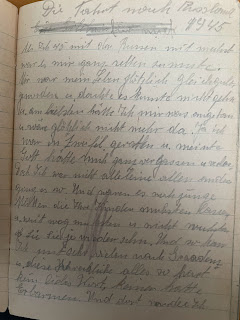
While my mom regularly derided my interest in books as 'brotloße Kunst' or 'breadless art,' I've scavenged bits and pieces of her own words written in her hard-to-decipher handwriting. Just recently, I found, inside what I thought was an empty journal, pages called "Die Fahrt nach Russland, 1945" or 'The Journey to Russia, 1945.'  Such a treasure which served to underline her oral sharings of those dark times. Crow Stone is based on her memories, after doing much background research.

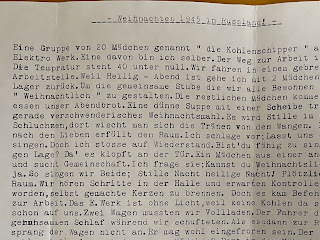
My mom actually had a piece published in Kanada Kurier a German-language newspaper, based here in Winnipeg. (It morphed out of the 1969 closing of  Der Nordwesten.)  I found Mom's yellowed newspaper article amongst her scattered papers, in between recipes and budget plans. Both newspapers were ubiquitous in our house when I was growing up. Now I scrounge to find copies!  Here's a translation of her published piece about Christmas as a prisoner of war. 


The Story of the Coal-shippers’ Christmas

by Else Schroeder 

(translated & edited for flow and clarity from the German by Gabriele Goldstone)

A group of twenty girls, called the coal-shippers, is working at an electric energy plant near Kurgan and Chelyabinsk in the Urals. I am one of them.

The distance to work is about seven kilometers. The temperature is -40 degrees and we travel there in the back of a dilapidated truck. Because it is Christmas Eve, two other girls and myself go back to our camp early to warm up the room we all share and to decorate it to look a little bit festive.

When the rest of the girls return, we eat our evening meal: thin soup and a slice of dry bread – not a very satisfying, elaborate Christmas dinner!

Back in our barrack, it becomes quiet. Here you hear someone sobbing, and there someone wipes away a tear from her cheek. Homesickness and longing for loved ones fills the room. I suggest we sing some Christmas songs, but there is opposition.

“Are you able to sing in this dreary place?”

There’s a knock at the door. A girl from another group is looking for company. I ask her, “Do you want to sing some Christmas songs?” She says yes, and so the two of us sing Silent Night, Holy Night.

Suddenly it’s dark in the room. We can hear footsteps in the hallway and expect an inspection. We had been told not to burn homemade candles. But instead, we receive orders to line up immediately to go back to work.  The electric plant is out of power and needs more coal. The old truck is already waiting for us.

We head back out and fill up two lorries. The truck driver has a nice nap while we slave. Then, when it’s time to return to our camp, the truck won’t start. It’s probably frozen.  Now what?  

“Wait here until someone comes to get you,” is the order. The guard points to a building not too far away—a stall for animals. It’s filled with cows, sheep and even a donkey.  

The night is cold, the sky, clear, starry. After the guard heads back to the main camp in his own vehicle, peace and quiet surrounds us. The animals are lying on their beds of straw, and us girls, tired and worn out from the cold and work, do the same, trying to get some sleep.
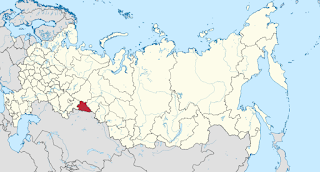
Kurgan Area in the Urals. Wikimedia Commons
But one of us has to stand guard, and that one is me, because I have been made their leader. While the others sleep, in my mind, I am participating in the Christmas story. The stars so bright. The animals in the barn. Everything leads me to Bethlehem. I am celebrating Christmas with twenty other girls and still I am all alone. 

Finally, it’s morning.  Another truck fetches us for some breakfast and then it’s back to work again, back to shovelling coal.

That was my Christmas in the year 1945.


Christmas Milestones

After the war, my parents, like many involved in the Second World War, had a lot of catching up to do with regards to raising a family. My parents married in 1952, came to Canada in 1953, and I was born in 1954. I was an important piece of their dream for their new life in Canada. 

Homelessness had defined the first 35 years of my mom's life and she was eager to be tied down by domesticity. My dad, on the other hand, having lost his first two children along with his marriage during the war, was eager to rebuild what he'd lost. 

Little Gabi's first Christmas was spent in the Wolseley area of Winnipeg on Lipton Street. I cycled past the house this summer, imagining my parents fussing over this new little Canadian in their life. Little angel, I was not!

Christmas always seem to mark milestones in people’s lives. What will Christmas, 2021, be remembered for, sixty+ years from now? The final year of the COVID pandemic, or the peaceful year before things got really bad? Grateful for what I have, right now. 


Grüß Gott from inside a Snow Globe

As winter snuggles in to rest during the dark days of December, I remember my first December away from home. I’d been backpacking through Europe and my friend and I used our Youth Hostel or Jugendherberge guide to show us the way. Some hostels had closed for the season and so we had fewer options. However, our Inter-rail Pass continued to open up new worlds and new experiences, even as we found ourselves colder and a tad lonelier than in the fall. 

Traipsing through the Austrian Alps was like being in a Christmas card. I don’t recall the name of the village where we disembarked, this one time, but it was off the beaten track. The train station attendant nodded a curt good-bye and pushed us out of the station with a “Guten Abend, my Fräuleins.”  He then locked the door behind us and we were on our own. Snow fell in the purplish light of the growing night as the mountains seemed to close in around us.

My friend and I stood under a lamplight trying to figure out which way we had to go to find the youth hostel. Nothing made too much sense, so we decided to just started walking. The place was tiny. Very tiny. More of a hamlet than a village. We passed by a woman wearing a kerchief and shawl, sweeping snow from her sidewalk. 

“Grüß Gott,” she called out. I responded with my own “Grüß Gott.” I’d learned the expression months earlier while working in Berchtesgaden. It literally means, “Greet God” and is a blessing, of sorts. After we passed the woman, we soon came to the end of the road and the end of the village. No hostel. No restaurants. Not even an expensive Pension to consider.  

We studied the hostel guide. Turned out that there were two similar-sounding villages in the area and we’d gotten off at the wrong stop. Now what? The train station was obviously locked but still we headed back there to read the train schedule. Next train wasn’t scheduled until morning. 

So we stood in front of the station, snow falling, darkness growing, my feet wet and cold and my backpack suddenly feeling much too heavy with my Canadian flag on it quite useless.

The only soul in sight was the woman, still sweeping snow. She now gestured to us. Was she was going to tell us not to loiter?  We’d discovered this was frowned upon at other train stations. 

However  . . . close-up, the red-cheeked woman’s eyes twinkled with warmth. Her German, full of mountain dialect, was hard to understand and I had to concentrate on every word—but her welcoming invitation was obvious. 

Inside her quaint, alpine-style cottage, with its gingham tablecloth and heavy wood furniture, a blue-tiled Kachelofen (ceramic wood stove) kept the place warm. We ate a satisfying soup with dumplings and then sausage and bread with hot cocoa. She smiled as we gobbled down the delicious food.

Later she brought out a photo album and shared pictures of a young man . . . her son.  It turned out that he was hitchhiking through the States and she hoped that by looking out for us, someone would be looking out for her traveling son. 

Later, we slept up in the loft, under comfy feather duvets. In the morning, we ate a Bauern Frühstück with ham and eggs, hearty bread and good strong coffee. We hugged our good byes and headed off to catch the morning train as the sun reflected brightly off the snow-capped Alps. 

I’d almost think I made all this up, but my friend remembers it too. Such is the gift of travel and of being vulnerable. It was one of the best Christmas memories I’ve ever received. 


Christmas is Complicated


For the record (no pun intended) I didn't listen to just German music as a young person.

 “Sometimes change comes at you like a broadside accident.” That’s Joni Mitchell’s line and I consider it my line, too. It’s been 35 years since that December 3rd collision with the Greyhound bus. I wasn’t in the car, but when the police drove me past the crumpled heap that carried my firstborn and my husband, I was too terrified to ask questions. 

I spent the rest of that December holding my only slightly injured daughter (car seats work!) while visiting her father in ICU. I still remember the beeps, the smells, and stranger sniffles from another bed over. I remember visiting a mall during those pre-Christmas weeks and feeling like an alien.

For Christmas Day, we got promoted to the Neurology Ward. It was our first Christmas as a family and our daughter was cutting her first tooth at seven months old. Her dad, still alive after surgery and a two-week coma, had a serious brain injury which has haunted my 37-year marriage. I took home a reasonable facsimile of the man I’d married and, I can’t lie, in spite of  hope and positive thinking, it’s been a struggle. 

All this about my personal life, just to say that December is complicated for many, if not most, folks.

The other day, I heard a podcast interviewing the wonderful Shelagh Rogers, host of the Next Chapter (her weekly program should be required listening for any writer) on CBC. She spoke of her own experience with an accident when she went through a car window. The splinters of glass in her face took years to emerge. That describes my process of dealing with our own traumatic event. The splinters lie there, sometimes for decades, but eventually they surface. 

What’s that other Joni Mitchell song? The one about Christmas and about the river? Yes, that one. That fits, too. A snowy river? Sounds perfect.


Winter Solstice in nazi times

The family canine insists on three regular-scheduled daily walks and nowadays, by five p.m. it's dark out. Of course, the snow helps to brighten things up and besides, it’s not ever really dark on the streets of suburbia. 

Broken Sun Wheel - Silsor  Wikipedia

Yes, winter solstice is almost here and soon the light will again champion the dark. I take great comfort in the consistent rhythms of the seasons . . . old enough to know that darkness, like light, never lasts. It’s all good. 

The Nazis embraced winter solstice and used old pagan symbols to their advantage. I've included this pagan representation of the broken sun wheel. The Nazis had a hard time with Christmas and the birth of the Jewish baby that it celebrated. Most German people loved the holiday and so the Nazis tried to accommodate both Christian and pagan traditions.

Part of my research for my upcoming novel involved interviewing . . . I’d rather call it, sharing a kaffee klatsch . . . with old family friends who grew up during the Nazi years. One particular image from a conversation stayed with me. 

A woman showed me a picture she’d drawn, as a young child using crayons, of a swastika rolling up (or is it down?) a hill. It was such a striking image that I had to borrow the idea for a scene in my book. The swastika represents the sun and it rolls up the hill to bring light into the world. Nature, pagan tradition and political propaganda . . . succinctly tied into one child’s drawing. Terrifying.


Recent Posts

Writer's News

I’m darn happy to share a bit of my writerly journey on a podcast, ‘ A Writer’s Life ’ hosted by the gracious and fabulous host, Heige Boehm...