Showing posts with label east prussia. Show all posts

People and their Landscapes

I’m currently immersed in Ulla Lachauer’s book, Ostpreußische Lebensläufe (1998). It had been gathering dust on my bedside shelf for a long while. Not sure why I was avoiding it. Perhaps it was the effort required to read German. Perhaps it was the dark contents. After all the research I’d done for Crow Stone, about the downfall of East Prussia, I was leery of going into another dark abyss. But it’s January and full of resolution, I decided to get the dark, heavy reading over with first.


Turns out, I had nothing to fear. Ulla Lachauer writes in an engaging, easy-going style, that didn’t stress this English reader too much. It’s not a book about war, it’s about people and this book showcases her obvious empathy for the ten East Prussians featured here. She highlights the resilience of these characters shaped by their Baltic environment and the difficult years of political turmoil.

Photographs add to the depth of connection the reader gets to enjoy. I found myself turning, again and again, to the images searching out the stories etched in their faces like they're  landscapes of their lives. 

Portrait of my mom done by Julia Penny

As I read, I’m searching the internet for names of tiny, forgotten villages mentioned in the chapters, checking to see if I might have cycled past back some of these ruins back in 2019 when I explored the Lithuanian and north Kaliningrad area near the city of Klaipeda (once Memel).

This beautiful, conflicted area comes to life for me again as I read this book and I can imagine my own family members living their simple, rustic lives … trying their best to survive. Aren’t we all?  So grateful for books like this. 

Ruins near the Baltic in former East Prussia


It's not 'just' Fiction

Super excited that my research and writing has led to a connection with the real person who inspired a fictional character in my 2022 novel, Crow Stone. My aunt, my mom’s youngest sister, had cared for a little girl during the life-changing 1945 winter trek in former East Prussia as they tried to escape the Soviet army to reach the rescue ships at the Pillau harbour. My aunt was still a teenager and this child she protected was a toddler between two and three years of age. What happened to my aunt and the child after 1945? While my mother spent the next 2 ½ years in the Urals as a Soviet p.o.w., (fictionalized in Crow Stone) her two sisters and this child stayed behind as northern East Prussia transitioned into the Kaliningrad enclave belonging to Russia that we know today. 

Crow Stone characters inspired by people still living

In 1953, after finding each other again, my mom and her sisters—once again homeless— immigrated to Canada. But the little girl, E.., by then about 10 years old, was left behind in Germany. I don’t know the details, but I think she was reunited with some family member in Schleswig Holstein, a province in northern Germany. This little girl, E. is coming to Canada next year and we’re going to meet up. She’ll be able to share with me some of the details of her tragic childhood that have been buried over the decades.  I’m just tingling with excitement. She’s read Crow Stone and I was quite nervous about how she’d react to this fictionalized account of those horrible times … but the fact that she’s eager to meet me and share more is a positive sign, right? I’m just thrilled!

My mom (right) and her youngest sister, 40 years after the war,
safely growing old in Canada

As we age, it’s childhood memories that creep back into the centre stage our consciousness. I may have been born and raised in Canada, but the leftovers of my family’s trauma have haunted my own life. Writing these trauma-focused novels has helped me process the dynamics of my family. Every family has stories worth exploring. We just need to ask the questions and remember to be kind, curious and brave. 


Brennessel

One of those curious German words that I’d hear growing up alongside Wanzen, (the dreaded bedbugs of Mom’s gulag days), and Quasselwasser (a type of drinking water that made little girls chitchat too much) was Brennessel.


Skalle-Per Hedenhös

Mom and her sisters or other women with similar immigrant and refugee backgrounds from the church would reminisce about ‘Brennessel.”  They talked about Brennessel soup, tea, salad or using it as an ointment.  They talked about Brennessel as if they loved it and as if they hated it.  Brennessel belonged ‘over there,’ in the faraway, dark and gloomy past.

Lo and behold, ‘Brennessel’ has an English translation. Of course! It’s the stinging nettle and it’s sold in health food stores as a nutritional superfood and as a possible tonic for arthritis. An interesting side effect of consuming brennessel is that it’s been known to cause miscarriages. That’s a useful bit of trivia for my writer-brain.  

I’m working on a novel set in East Prussia at the end of the war. My characters are hungry. It’s April and they’re in the woods trying to avoid the Red Army. What will they find to eat? Brennessel, of course... along with some mushrooms. Haven’t looked into those yet. But I’m encouraged by the fact that East Prussia and rural Manitoba share many plant species and have a similar climate. So, like my characters, I’ll be in these early spring woods foraging for edibles.  At least I don’t have to dodge enemy bullets, or drunk rapists while I meander. 

Cycling through the Kaliningrad region back in 2019, we passed fields of stinging nettles. I’m so grateful that we kept going. Grateful that we had no need to rely on wild brennessel for food, to end unwanted pregnancies, or to soothing our aching muscles … unlike my aunts, cousins and mom did almost eighty years ago. 

I found comfort in seeing the wild brennessel ... a confirmation to my mom's stories. 


Immigrants


As I prepare for a rare family reunion (in Mexico, of all places!) I remember the family members who won't be there. 


My grandmother Matilde and her youngest son, my uncle Jonathan
... both died during Siberian exile
But, at least now I know they once existed and a little bit of the story. 


Former East Prussian refugees arriving in Winnipeg, Canada, 1953


Learning about those who never had the opportunity to immigrate. 

The orphaned children left behind in East Prussia
The Wolf Children of the Eastern Front


The immigrant church in Winnipeg filled with displaced survivors
who turned to faith for healing. 


Where a daughter of immigrants 
tries to figure out who she is


Wild Children

My mom had it tough as the Second World War wound down on the eastern front. I explore the failed winter exodus from East Prussia in Crow Stone … my YA release from Ronsdale Press, from back in 2022. Of the three sisters, fictionalized in the novel with the names of Katya, Sofie and Marthe, only Katya (inspired by my mom) is taken into the Soviet Union as a forced labourer. She went through some difficult times in the open pit mines of the Urals near Chelyabinsk. 

But what happened to her two younger sisters? I understood little about their experiences. Things were just too terrible to remember, they’d tell me. Let the past be forgotten, they’d say.  I knew rape and starvation were common under the Soviet occupation. I knew they weren’t allowed to leave the former East Prussia, renamed Kaliningrad, until 1948. I knew that others in my immigrant church community had similar experiences … but no one would talk about it.


So now I’m reading The Wolf Children of the Eastern Front, Alone and Forgotten, by Sonya Winterberg with Kerstin Lieff. It’s a heart-wrenching testimony of the horrors that lost children experienced in those stark years after the war. Unlike the dates in history books … the end of war doesn’t end the suffering. 

As a curious side note, the introduction to this book is by John Kay, the lead singer of the Canadian rock band called Steppenwolf. Born in Tilsit, East Prussia (now Sovetsk, Kaliningrad) in 1944, he narrowly escaped a similar fate that 20,000 young East Prussian children experienced. John Kay (born Joachim Fritz Krauledat) ended up in Canada in 1958 and went on to create memorable hits like “Born to be Wild.”  

Many children scavenged like wild animals in the desolate, bombed-out East Prussian countryside. My two aunts, fostering a lost toddler, and my teenaged cousins no doubt would have crossed paths with the orphans as they foraged for food trying to avoid Soviet revenge near the Lithuanian border. 


Puzzling Memories

My aunt who inspired 'Marthe' in Crow Stone
Crow Stone was inspired by my mom who died back in 2011 at the age of 92. I’d been collecting her chaotic memories all along, and later put them together into narratives … filling in the missing pieces with background reading and travels … almost like doing a puzzle. As I quoted Kate Morton, last week, I was fulfilling the universal human need to create a narrative.  

A few months after Mom's funeral, I visited her youngest sister who'd been unable to come to the funeral. This aunt lived up in northern BC and passed away the following year.  It was from her that I learned the story about the child she'd fostered during the flight from the Soviet Army in the final months of the war. She claimed that it was this little girl, whom I call ‘Erika’* in the novel, that saved her from my mom’s fate in a POW camp in the Urals. My aunt was 19 in 1945 and looked after little ‘Erika’ until she came to Canada in 1953 after ‘Erika’ had finally reconnected with some of her own family. 

My aunt, date unknown, prob. about 1950

I’d been trying to meet up with ‘Erika’ as I researched the book, to no avail. Imagine my thrill to now finally connect via email. Imagine my surprise to have ‘Erika’ asking me to fill in the details of her early childhood. Imagine my absolute delight to be able to share my book and my research with this woman, now in her early eighties, living in northern Germany. 

from The Guardian, Jan.3, 1947, p.8

I told ‘Erika’ of how much my aunt loved her. My aunt had shared stories about how the surviving East Prussian women and children were forced to work in the newly formed collectives or kolkhozes’.  Those were extremely difficult years. Food was scarce ... hunger and disease was everywhere. But my aunt, smiled with gratitude as she shared, “little ‘Erika’ was our sunshine as she sat amongst the vegetables with us as we worked. She sang to us with her sweet voice and gave us so much happiness.”

To be able to share this memory with the real ‘Erika’ makes me so very happy. Of course, I sent her a copy of Crow Stone. I know it’s not the factual truth … it’s not a memoir. But the magic of story transforms facts into emotional truths that can be just as valid. 

It's making these sort of connections that makes my writing and research efforts seem so worthwhile.


*See Crow Stone, pages 91, 98 and 101 for mention of Erika

welcome sign of collective or kolkhoz in the former USSR
from my own collection
'


Fragile Places


Border between Kaliningrad Oblast (Russia)
and Poland (NATO) in 2019
Yes! Grateful for a 5 star review from CM Review (Canadian Materials). Hope this will encourage readers to pick up a copy
of both Tainted Amber and Crow Stone. Understanding history helps us to understand the present global conflicts. 

I’ve blogged a lot about East Prussia, the eastern-most province of the former Third Reich that became Russia’s most western enclave. At about 15000 square kilometers, it’s a third of the size of Prince Edward Island. For more than seven decades it’s been not much more than a ghost town … de-populated of Germans, re-populated by transplanted Russians (a man from Kazakhstan lived in my uncle’s former house) and dotted with the ruins of war.  Today, as Putin rages about how German tanks are again confronting Russian ones, this area is a stark reminder that the conflicts of the past are not resolved.

Baltic Sunset near the Lithuanian/Russian border
Pillau—on the Vistula Lagoon—was once the desired Baltic port of refuge for civilian refugees like my mom. The Russians renamed it Baltiysk.  

As a Russian naval base, it’s in a restricted zone and shares (along with the capital city of Kaliningrad) the only year-round ice-free port on the Baltic available to the Russian military. Even when cycling near Baltiysk, along the beautiful, sandy Amber Coast, we could feel the ground rumbling and hear the dull explosions from military exercises.

Kaliningrad Oblast is surrounded by NATO countries… Lithuania to the north and Poland to the south and east. However, there’s a 65- kilometer-long border near the Polish town of Suwalki that makes the Baltic countries’ vulnerable. This short border is all that separates the three NATO countries of Lithuania, Latvia and Estonia from Belarus, Russia’s ally. I expect that we’ll hear more of these three places: Baltiysk, the Suwalki Gap, and Grodno (the closest Belarusian city) in the coming months. Will Kaliningrad/East Prussia ever heal?


Rest in Peace ... Live in Peace

The story of Crow Stone … out in just a few days … begins on November 11th, 1944. Here’s the opening paragraph.

November 11. Today is Albert’s twenty-fourth birthday and he’s coming home to celebrate. Well not home, home, but what’s become home—Königsberg here in East Prussia. I’m meeting him at the train station, the same station where we arrived when we were homeless children—kulak orphans. Will I even recognize Albert? The men all looks the same in their grey field uniforms.

His brief visit will be the last time he gets to be with his family. Inspired by my mom’s real brother, August, he soon disappears into the quagmire of a Soviet Union prisoner of war camp.


Two months later on a Red Cross/Crescent postcard, dated January 17, 1945, he writes, ‘Things are going well so far, wishing the same for you. Hope we can soon reunite in our homeland.’ Well, there was no homecoming, no home to return to, and no future. 

This Remembrance Day I want to remember that war kills. It kills the enemy, the hero, the child, the old woman, and the family dog. War doesn’t focus on a uniform or on an age.


Solzhenitsyn, Public Domain


In Prussian Nights, a narrative poem composed by Solzhenitsyn and committed to memory while he was in the Gulag after being accused of empathizing with the enemy, he remembers war.

Some soldiers have gathered round

          A pram that’s been abandoned,

Blue,

Lace trimmings, too:

’Look, a little ‘un.

Still, he’s a German!

He’ll grow and put a helmet on.

Deal with him now, d’you think?

The order from Supreme Command

Is Blood for Blood!    (p. 67. Prussian Nights, translated by Robert Conquest)


Rest in Peace, Uncle A. Let me never take this living in peace for granted. 


On Mom's Trail


(This is a copy of an article I prepared for SGGEE (Society for German Genealogy  in Eastern Europe) It can be found in its most recent journal, available to members only. (Vol. 24 No.1  2022 March). 
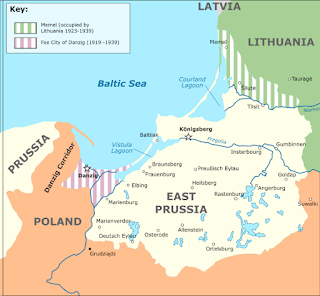
creative commons
It’s long been an ambition of mine to physically retrace my Volhynian-born mother’s footsteps. With Don Miller’s guidance, I started at the beginning, in Federowka, 35 kilometers northwest of Zhitomir. That’s where the storks dropped off Else Ristau back in 1919. On that roots tour, in 2004, I visited Zhitomir’s secret police files and perused documents which convicted my grandfather—former windmill owner, Eduard Ristau—as a class one kulak, guilty of counter-terrorism.  I viewed the ditch where they dumped his body in the fall of 1937 during the Great Terror and even looked for happier times in nearby Pulin, where Mom was allowed a sip of her father’s dark and bitter beer. Most dear to me were the granite remnants of the Ristau windmill discovered with the help of Helene Nickel, an older woman in Federowka. I tucked a piece of its red granite base into my mom’s pocket when she was buried later in 2011.   
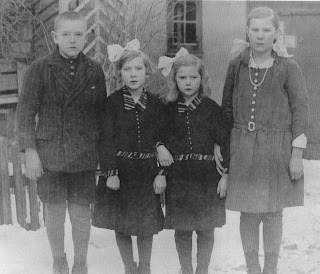
Kulak orphans in Kreuzburg


That 2004 trip became an important turning point for my sense of self.  Growing up here in Canada, without much of a history—my mom having only a confused and limited point of view of what she’d been through—had left me feeling untethered, detached and without a true identity. With the help of SGGEE, and much reading, I now have a rich inheritance and a much stronger appreciation of my place in this chaotic world affected by war, social unrest, and now, even a pandemic.  How rich we are when we discover our past. 

My mom survived her Siberian exile as the child of a kulak and in 1932 ended up with Ristau relatives in Kreuzburg, East Prussia (now Slavskoye, twenty kilometers south of the present city of Kaliningrad). In the fall of 2019, I cycled through these East Prussia parts of my mom’s life. 

The former Ostpreussen (East Prussia) no longer exists as a political entity. Germany’s easternmost province is now divided amongst Russia, Poland and Lithuania and while Lithuania and Poland have prospered in the thirty years since the fall of the Soviet Union, the tiny Kaliningrad Oblast continues to be a rather forlorn part of eastern Europe—a place for Putin to test his missiles within shooting range of the rest of Europe. 

The guided adventure began in Riga, Latvia and we alternatively biked and drove down to Klaipeda, Lithuania. Klaipeda, once the German city Memel, sits right on the Baltic. There we admired a statue of Ännchen von Tharau. (Germans might be familiar with the famous folksong about her.)  Back in the 1930s, her statue had incensed Hitler when he realized she had her back to him while he orated a victory speech from a balcony overlooking the public square. 

From Klaipeda, we took a ferry across to the Curonian Spit—a scenic ninety-eight-kilometer long strip of ecologically-fragile land, a Unesco World Heritage area, divided between Lithuania and Russia. On the Spit, we encountered huge drifting sand dunes, wild boar, and migrating birds. It was during my 2004 trip to Ukraine with Don Miller that I learned to appreciate birds . . . especially the storks and the cuckoos. Our East Europeans ancestors were closely connected to nature and this is reflected in their culture—including their songs, poems and memories.

Our small group (there were six of us) stayed overnight in Nida (Nidden), a resort town made famous by Thomas Mann who spent several summers there, and established a writing colony, after receiving the Nobel Prize for his novel Buddenbrooks in 1929. Later, the Nazis confiscated his place and turned it into a convalescent home for recovering Air Force officers. My father, himself at one point an injured Luftwaffe officer, was never amongst the privileged elite . . . a good thing, I’d say.

From Nida, we continued to the Russian half of the Spit. While there was only a modest entry point, it felt intimating entering Russia on a bike. The border guards took their job seriously with fearsome-looking guns and barking dogs. I was grateful for our multi-lingual guide who got us safely across and I’m sure he was grateful, too.

The difference between Lithuania and Russia on that Curonian Spit was felt as soon as we used the park washrooms. I preferred the natural setting of the bush (even with the stinging nettle or possibility of wild boar), to the filth of the offered outhouses. And yes, we did spot wild boar, along the road as we cycled. 

In spite of the dirty washrooms, this part of Russia had an inviting rustic charm. We stopped in Rybachy (formerly Rositten), which had been a renowned German migratory bird research station and is still used by Russian naturalists. Climbing the sand dunes was an amazing—and exhausting—off-road adventure. Because of the delicate nature of the dunes, we needed to stay on marked paths. Entire villages have been buried by the drifting sand dunes over past centuries. Good luck finding clues to ancestors in those villages. 

Our first night in the Kaliningrad Oblast was in the former spa town of Cranz (now Zelonogradsk). This area along the Baltic is also known as the Amber Coast—and yes, I hunted for amber—unsuccessfully. Later I bought some at one of the ubiquitous kiosks selling very affordable amber jewelry. 

Aside from natural beauty, the German influence is still strongly reflected in the architecture of Zelonogradsk. While Russian corruption or confusion has left some of the modern beachfront hotels indefinitely unfinished, old German villas offer a laid-back ambience of a past era. Trains in the 1930s had regular-scheduled, heavily-used routes for the East Prussians to enjoy the Baltic Sea breezes. 

It’s nearby along this same coast, by the Palmicken amber mines (now Yantarny) that Nazis forced thousands of Jews into the icy Baltic back in January, 1945. So much history, so much loss, along these scenic shores. Unlike visiting Ukraine, where a woman tried to spit in my German face, I found more awareness here of the positive aspects of German influence. 


On to Kaliningrad, the capital city of the Kaliningrad Oblast. Known as Königsberg since 1255, and the birthplace of Immanuel Kant, the city was decimated during the final months of the Second World War. My mom had shared tales of using the city tram and of window shopping in the once prosperous city. My personal obsession here was to eat Königsberger Klopse in a local restaurant. 

There’s little in Kaliningrad to remind a German tourist of the past. This was Stalin’s intent and he’s succeeded. However, The Dom next to Kant’s memorial, has recently been rebuilt. Even the Russians. . . transported here to replace the exiled Germans . . .  admit that Königsberg was once beautiful and embrace its complicated history. I felt overwhelmed with a sense of loss.  The brutalist House of the Soviets, (behind me in the photo), was built in the seventies to replace the war-damaged Königsberg Castle. It’s never been used or even finished. Back home, when I shared my trip with an older German woman who’d survived the devastation of East Prussia, she reminisced about how the chestnut trees began to bloom in January, 1945 because of the heat from the fighting. Now the downtown core was mostly concrete and traffic.

I’d prearranged a side trip while staying in Kaliningrad to visit the former Kreuzburg, my mom’s hometown during the 1930s. Now called Slavskoye, it’s about 20 kilometers south of the city.  We drove, rather than biked, to this town and upon retrospect, that was a bad choice. The traffic jam, leaving Kaliningrad city, was terrible. Did everyone have a dacha out in the countryside? Our Belorussian driver, Igor, slowly inched past the modern sports stadium built for the 2018 World Cup.  He didn’t hesitate to use his horn or even boulevards as necessary. Finally, we were out. 

Unlike the city which was rebuilt with the ugly Soviet-style concrete monoliths, rural areas of this oblast are marked by derelict ruins leftover from the German years. I was especially charmed by more of the majestic linden and chestnut trees lining the roads. Like the birds, trees and perennials tell stories of past generations. This was the East Prussia I had visualized. All that was missing were the Trakehner horses for which East Prussia was once famous. 

Similar to making family connections in Federowka back in Ukraine, I felt myself nervously anticipating what I’d find here in this hometown—this neglected time-warp of Europe—wedged between the past and the future. The Germans had all been forcibly expelled after the war and the area had been repopulated with unmoored people from the rest of the Soviet Union. A lot of the good, arable land still lies dormant—beautiful but wild. 

I was delighted to walk down the broken cobblestone main road of the former Kreuzburg and thrilled to later find the house where my mom found shelter with East Prussian relatives. Yes, the house my uncle had built in the 1930s was still standing. Earlier, I’d discussed its location with my one surviving cousin now living in BC.  “At the end of the road, in the ‘Schul-siedlung’ (school neighbourhood) with a well in the front,” she’d told me. We asked for help along the way and found it, just like she said. 

Second World War bullet holes still marred the house exterior, but on the whole, the house was lovingly looked after by an old man resettled from Kazakhstan who was proud to walk us through his beautiful garden. Time restraints, on account of the previous traffic jam, forced me to decline his offer for tea inside. His curious neighbour, her yard boasting a tree of ripe apples, was also curious about us. Wonderful people and I would never begrudge them my family’s former world.

Not far from the house stood the school my mom attended. The outside, still bullet-pocked and neglected, appeared to be used as an apartment with several residences. According to reports I’d read, by February, 1945, the Wehrmacht had sought shelter in the school while fighting off the Red Army. The village has an extensive graveyard for the fallen Soviets who died far away from their own homes here on what was once German soil.  Meanwhile, my mom’s younger brother, who disappeared during the last months of the war and ended in a Soviet camp, was never to have a marked grave. Such is war.

Our bike trip continued the next day and we cycled out of Russia into Poland. At one point, we cycled parallel to what was left of the Autobahn Hitler had started building for his Volkswagon. The Berlinka would have connected Königsberg to Berlin. Somewhere nearby would have been Stablach, a military establishment with a munitions’ factory. My mom worked there, and lived in its barracks throughout the war, cycling the eight kilometers back to Kreuzburg for visits. 

It didn’t us take long to reach the Polish border crossing at Mamonowa (the former Heiligenbeil) where we waited for hours as vehicles around us were taken apart. Dogs sniffed through everything. When it was finally our turn, our Canadian passports were greeted with a smile and a quick wave through.

In the winter months of early 1945, there was a different kind of slowdown on these roads. Back then, the snowy woods and pathways would have been jammed with military vehicles going one way, and mothers and children pulling all they could, the other way. Civilians tried to reach the ships waiting in harbours along the Baltic. They crossed over the icy, slushy Frisches Haff (Vistula Lagoon) from small towns like Frauenberg (now Frombork) to reach Pillau so they could board ships like the Wilhelm Gustlaff or the equally doomed, Goya or Steuben.  These ships offered them an escape from the Soviet tank armies, but not necessarily the Soviet Navy. More than fifteen thousand, mostly women and children, drowned in the icy Baltic in those early months of 1945.

It was misty, the day when I looked over the Vistula Lagoon . . . a brackish strait of water that in 1945 froze because of the extreme cold. It offered a welcome shortcut to the ships. I imagined the broken wagons stuck in ice as the low flying Soviet bombers strafed the desperate civilians. A poignant moment for me.  
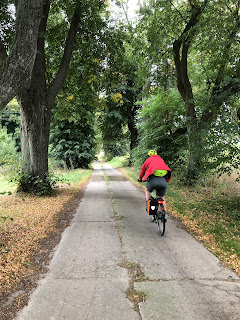
My mom and her sisters, however, never made it as far as the Vistula Lagoon. They were stopped by Red Army soldiers somewhere in the woods along the trails that I cycled. For my mom, it meant transport back into the Soviet Union of her childhood. It meant more than two years of forced labour in an open pit mine in the Urals. For her sisters, it meant working on a Soviet kolkhoz near Drobrovolsk (Pillkallen or Schloßberg) until 1949. As I cycled through the scenic beech tree woods, I had much time to ponder their loss of freedom, lots of time to imagine the bodies of the hastily buried under snow in the ditches along the way. Lots of time—especially when the cycling trail was uphill!

Cycling is a great way to appreciate a landscape and because I grew up with the echo of Ostpreussen in my ears, it felt a bit like going home. While we can’t travel now, we can research to make a future trip more meaningful. After all, genealogy and travel go together like good cousins.


Stablach Then, Dolgorukowo Today

Another place that I managed to get close to, back in 2019—but still didn’t get to visit—was the former Stablach, East Prussia. Once known as the Gartenstadt (Garden City), what’s left of the town sits in a forested area between two rivers in the southern area of the Kaliningrad Oblast near the Polish border. Now forlorn and neglected, dotted with ruins, connected via bad roads lined by stately linden and chestnut trees, it’s sparsely inhabited by relocated Russians. 

Stablach was first established in the mid-thirties and by 1939 it had almost three thousand inhabitants. Back then, this entire rural area bustled with growth.  Construction of the nearby Berlinka Autobahn had slowed down, while energy was redirected towards constructing support networks for the military. Stablach became an important military training centre for the SS and others in the Wehrmacht. A new church along with new homes were built for military staff, with plenty of room for the Aryan soldier’s dream family and their gardens. Another priority was a new prison, hastily erected by the first crop of Polish prisoners in 1939.


My mom lived in one of the newly erected barracks built for the munition factory workers. Being about eighteen kilometers southeast of Kreuzburg (now Slavskoye), which I did get to see, I could imagine my mom cycling on nearby tree-lined roads to visit her aunt and uncle.  My mom had been recruited—like many single women—to work in Stablach’s ammunition factory.  By then the prison (Stalag1A) would have been filling up with Poles, Belgians, French and fellow Germans.

The place is now, as part of the Kaliningrad Oblast, called Dolgorukowo. Supposedly the church was not damaged during the war and later used by the Russians as a horse stable, a cinema, and has now become a cultural centre. I’m curious about what this cultural centre shares.

There’s so much more to explore and how I would love to go back! My mom left the Stablach munitions factory in January, 1945 when the Soviets were closing in to finally destroy the madness of the Third Reich. It’s been so fulfilling for me to retrace her steps, especially as she moved closer towards the hell of the Second World War.  I hope my new book will bring these times to life. 


Trakehner Horses

A little bit about Trakehner horses. The what, where, when and why. 


             Tempelhüter
Alexander Kastler Wikipedia 
                                                                
                           What?

Trakehner horses are a multi-coloured, warmblood breed originating in the former East Prussia. (Warmblood means they have speed and endurance, cavalry material . . . as opposed to a drafthorse which is coldblooded and used for slower, heavier work.) They are identified through branding with the East Prussian moose antler.   


Where?
Joachim Kohler Wikipedia

Trakehner hoses are named after the East Prussian town of Trakehnen. Now part of the Kaliningrad  Oblast, it was renamed Yasnaya Polyana after the war. Located north of the Rominter Forest, in the southeast corner of Kaliningrad Oblast, it’s about 150 kilometers east of Kaliningrad city. While a Russian museum retells the famous past, the town—like most of rural Kaliningrad Oblast— is run-down and neglected. 


Stud House in Trakehnen before the war.
(Public Domain)

When?

The town of Trakehnen was established back in 1731 by the Prussian cavalry. On January 20th, 1945, the state-run stud farm was abandoned as the Soviets approached. Today, while almost completely destroyed at the end of the Second World, the Trakehner has once emerged as a strong horse, admired throughout the world. Now you can ride Trakehner horses even here in Canada. 

Why?

Because as I explored my mom’s ‘quiet’ years, I learned that as a young woman, she worked as a servant girl for East Prussian estate owners.  I soon discovered that East Prussia was well known not only for its idyllic countryside with pastures for grazing horses, but for a specific type of horse. Setting a novel against the background of breeding perfect horses was an opportunity to explore the Nazi obsession with bloodlines and their quest for perfection. 

Rebuilding history?


The cities of Gdansk and Kaliningrad (both former members of the Hanseatic League) were each re-built differently after the Second World War. Gdansk, now again part of Poland, has a beautifully restored old inner-city tourist area. Eighty-one Septembers ago, the Nazis had claimed the port city for themselves, called it Danzig and left it largely intact. Not until later, in 1944 and 1945, as Germans civilians fled to the harbour city to get on ships to avoid the advancing Soviet Army,was the city crushed by Soviet bombs. 

Last September I was in Gdansk, Poland finishing up a cycling trip. I’d biked in four countries and through some intense family history. The books I’ve read, both pre, and post trip, continue to enhance my appreciation of these lands. 

It was also interesting to view Lech Walesa’s shipyard office—the beginning of the end for the Soviet communism. Gdansk—a place of beginnings and ends.


A few days earlier, I’d been guided through Kaliningrad, once Königsberg. It was also destroyed by the Allies in 1944/45. When the former East Prussia was divided up after the war, Konigsberg stayed under Soviet control, and renamed Kaliningrad in honour of a Soviet hero. Because the local population was expelled, there was no effort to showcase or remember any of its history. It wasn’t until the 1990s that efforts began to rebuild the massive cathedral and even honour Immanuel Kant a German philosopher. Once quite revered by the Soviets, he's now causing irritation. Reminds me of our own changing views of history here in Canada.

Our yesterdays are complicated. We can try to erase the past by pulling down monuments, buildings, or renaming cities. It will continue to haunt our present. Educating ourselves is key to awareness, acceptance and finally, action.

Old stuff. So many stories. I was struck by how proud the guides were of both their cities and their complicated histories.

Going Off-leash

It’s countdown to my big trip. I’ve saved, I’ve planned, I’ve trained, but mostly, I’ve imagined, this 2019 Baltic Bike Tour and North Sea Meander for a long time. 

Last time I went overseas for family research was in 2004.  That’s when I found my grandfather . . . well, he was dead, but I found out where he was shot, the ditch where his body was dumped, and when. No one in my family knew that story. 

original SVG file created by
Matthead (based on East_Prussia_1939.kpg
from English Wikipedia)
This time around, I’m not looking for windmills or perusing former KGB files. This time, I’m looking for amber and traces of love amongst the Nazi ruins of old East Prussia. Who knows what I’ll find? That’s part of the thrill of the hunt—and yes, I truly do feel like an explorer out to discover ghosts of the past. 

Of course, there will be some voyeuristic tourism along the way. Riga, Klaipeda, Kaliningrad, Gdansk—these are cities that will be complete unknowns to me. But I’m more interested in the little places in between. And, I’m a fool for trees, stones and wrinkled old faces. That’s why a bike trip is the perfect way for me to explore this part of Europe. 

The second half of my five week trip will take me to Schleswig-Holstein, with a three-day stopover in Berlin. Another unknown city that I feel will shock me because I’ve mostly seen only the war images of it.  

Ahttp://www.maps-for-free.com
Then it’s on to Hamburg and the North Sea where I’ll be staying in a beach town, population 5k. That’ll be my headquarters for checking out my dad’s side of the family. I have a bit of trepidation. What family skeletons are still hiding here? 

After some back and forth, I’ve decided to go without my laptop. I’ll travel with pen, paper and my smartphone camera. When I come back in October, I just might be bursting with photos and thoughts about my adventure. 


Baltic Dreaming

From the Baltic Bike Travel website: www.bbtravel.lt
So excited! Finally, this meanderer gets to do some more off-road meandering. By that, I mean digging around for ghosts still calling for me from overseas. I’ve put down my deposit for a September bike tour from Riga, Latvia, through Lithuania, the Kaliningrad Oblast to Gdansk in Poland. Maybe I’ll find some remnants of my family. An old linden tree, perhaps? Stones, for sure. Amber, maybe. I'll get to hear the rhythm of those Baltic waves pounding the sandy beaches and shiver in the Baltic's salt spray. Can't wait!

For years now, I’ve been immersed in history books, photographs, films and memoirs set in East Prussia of the 1930s and 40s.  I've been digging up my mom’s tumultuous, pre-Canadian, life. 

Biking seems to be the right way to appreciate this natural and historical landscape. Now, if only Manitoba's snow would go away so I could get my cycling muscles into shape. 

Good time for more research. I’ll share some of my reading material soon. Check out the images haunting my dreams here. 

Exploring East Prussia

If you’ve browsed through my blog, you might know that I’ve been exploring my mom’s life (1919-2011). My first book, The Kulak’s Daughter, was set in a part of the former Soviet Union known as Volhynia. This area is now part of the independent country called Ukraine.

File:Weimar Republic 1930.svg I’ve been working on, and revising, a sequel to that book. It’s also set in a part of the world that exists only in history books and fading memories. This is a place called East Prussia. When my mom left the Soviet Union as a thirteen-year-old orphan, she was adopted by extended family who were farmers in East Prussia near the city of Königsberg. Today, Königsberg is part of Russia and known as Kaliningrad.

It’s a confusing part of the world, and the 1920s/30s/ and 40s were confusing times. I’m a slow learner, but I’m gradually getting an idea of what life was like. The one thing that did stay the same was the people. Teenage emotions, human relationships, and ambitions have remained constant throughout time. So this will be at the core of my writing, even amidst the chaos of eastern Europe in the 20th century.

If you look at this map (Creative Commons, free download) - you can see that East Prussia is separated from the rest of Germany. Poland divides the two parts of Germany. This is why Hitler invaded Poland in 1939. This Weimar Republic - created after WWI - is the predecessor of the fatal Third Reich.

In this brewing kettle of trouble, my orphaned kulak mother spent her confusing teenaged years.

Recent Posts

Writer's News

I’m darn happy to share a bit of my writerly journey on a podcast, ‘ A Writer’s Life ’ hosted by the gracious and fabulous host, Heige Boehm...