I grew up in
a German immigrant family that carried a lot of silent guilt. Guilt can be heavy, messy and complicated. Small wonder that religion was so important.
The word refugee was a common term in our house. The
German word is Flüchtling
(literally meaning: person in flight). Growing up, there were two kinds of
Germans…the Reichsdeutsche (someone
from Germany proper—they had status) and the Flüchtlinge (this word had a condescending feel to it). These were my childhood impressions.
The word “Reich”
literally means ‘kingdom’ or ‘empire’ as in Hitler’s Third Reich. The Third Reich, was an attempt to rebuild after the
failed “Second Reich,” (formed in 1871 under Bismarck with the unification of
the German states) and ending with the German defeat in 1918. (The First German
Reich was the Holy Roman Empire from 962-1806.)
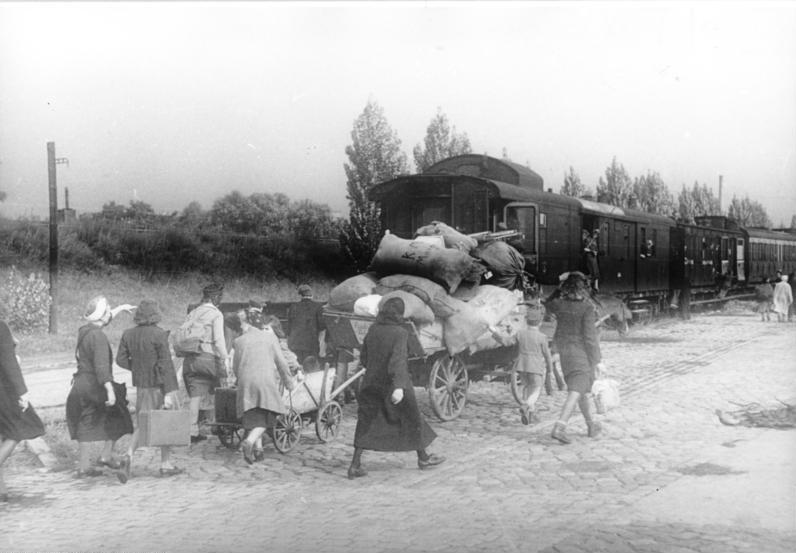 My dad was a Reichs German and my mom was a Flüchtling. As a child, I confused ‘Reich’ with ‘reich.’
The noun and the adjective. To be ‘reich’ means to be rich. And this certainly was
the case. The Reichs Deutsche might
have had bombed out homes, but they still had homes. The Flüchtlinge had to flee their homes, their farms
and their villages. They had literally nothing—not even photos, and few
documents. For example, my mom had no birth certificate.
There’s
another term synonymous with the Flüchtlinge of my
growing up years: Volks-deutsche. A Volk-German is an ethnic German living
outside of the Reich. There were substantial German populations throughout
Europe: Poland, Czechoslovakia, Hungary,
Romania, Soviet Union, Lithuania, etc. In most cases, these people had been
living peacefully side-by-side with the locals for centuries.
Hitler changed all that with his push for Lebensraum. When the war ended, the Allies determined that the best
way to solve the German problem was to force all ethnic Germans into
Germany proper. And that’s what happened.
Moving
between twelve and fourteen million people (mostly women, children and elderly)
identified as German between 1945 and 1950 became the largest ‘ethnic cleansing’
in history. It happened at a time when resources for the whole continent were
limited. No country had extra food for millions of homeless, needy people. Consequently, it
was an expulsion with horrific suffering. Because the ethnic Germans had
benefited under the Third Reich there was little sympathy for their subsequent plight.
Whether they were babes in arms or bedridden elderly, they were German and therefore
they had to pay for the crimes of the Nazis.
It’s because
of this guilt that their stories have been hushed. I’m not trying to judge the
morality of this. Rather, I’m trying to understand the experiences of my family.
All of Europe was a quagmire of
suffering throughout the forties. I’m exploring this ugly time of humanity
because it had a such a major impact on my immediate family. Nobody would or
could explain their stories to me while I was a kid growing up in the suburbs
of Winnipeg.

History books
never gave more than a few passing references to the expulsions. That’s why I
devoured R. M. Douglas’s book, with the ironic title:
Orderly and Humane:
The
Expulsion of the Germans after the Second World War. It finally gave me a
sense of perspective—gave voice to the guilty silence. It also helped me to
understand the difference between the
Flüchtlinge who
were fleeing the Soviet advance in the winter of ’45 and the people displaced
because of a desire for revenge. These people were forced to leave their homes,
detained in transition camps and finally shoved into overcrowded freight trains
and dumped into a bombed-out Germany.
The country obviously had no resources to absorb the millions of
newcomers. The Allies supervised this ethnic cleansing, while Nazi leaders were
being tried for the same crimes.
Politics matter. Let's make sure we don't vote for leaders who have hostile intentions against our neighbours.
Refugees are flooding Europe today—more than six million Syrians seek new homes. They will need to tell their
stories, too and we must listen because it’s through story that we heal.
Top photo attribution: Bundesarchiv, Bild 183-1983-0422-315 / Donath, Otto / CC-BY-SA 3.0


