Happy 2017

While the consensus appears to be that 2016 was not the best of years, my personal take on the year is more favorable. Nobody in my family died, we didn’t move (in spite of a good deal of deliberation), I didn’t lose a job (have none to lose), no divorce, and not even a pet died. (The laptop doesn’t count.) It was a good year. In fact, it was a very good year, one of my personal best. I read, I wrote, I walked, I gardened. Maybe even in that order. Of course, it’s deep winter now and gardening is limited to remembering to water the houseplants…something that I’m working on. Still, it was a good year—serene.

Reading
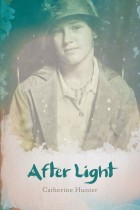
After LightI find Goodreads a useful way to track books, reviews and wish lists. However, I do find it annoying to count books read. Numbers are quite irrelevant. I have a few hours a day set aside for reading and some books are longer, more difficult, or in German. So I don’t judge my reading by number, I judge my reading by personal impact. My favorite book in 2016 was Catherine Hunter’s After Light. I’m disappointed that it wasn’t a Governor General Award finalist.

On to 2017. Here’s a glimpse of my to-read pile—a scattered bunch of books gleaned throughout last year.  I’d like to get through that and who knows what discoveries 2017 will bring. Reading. What power in mere ink on a page.

Writing
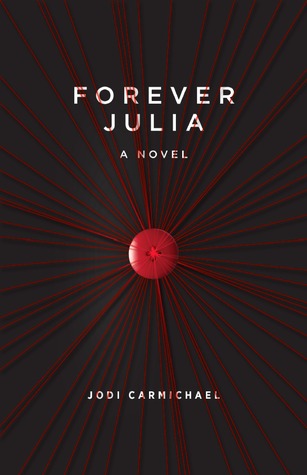
Forever JuliaThe writing is going. I’m working on an early draft of the fourth book in my Katya’s Stones series. I think I live in the perfect environment to appreciate what my characters must endure—not that I can come even close to imaging the horror of the winter in 1945 East Prussia. I was pleased to see that Broken Stone received a ‘highly recommended' review on CM Review and shortlisted for the Manitoba Book Awards for Young People back in the spring. The award went to my friend, JodiCarmichael, and I was and still am thrilled for her. Forever Julia is an energetic and empowering book for teenagers.

Walking
And I continue to walk, swim and cycle. I love the rhythm of these activities, prefer doing them alone—although I’d never say no to some company. Most any conversation improves with a walk. Most any problem improves with a walk. My night walks with the canine are crunchy on the crisp snow and I’m proud of how this winter city ploughs through snowfall after snowfall to give us driveable streets and walkable sidewalks.

Gardening
Green stuff is on hiatus until spring. I sure appreciated the inspiration I found in other's gardens last year.  Can't wait to dig in the dirt. In the meantime, I revel in the white stuff. We have a lot this year. It’s different now that I’m not working in it. I get to admire winter's austere beauty in a more relaxed manner.

So for 2017, I want more of the same. More reading, more writing, more walking, and more gardening.  These are my habits. I’m not much of a resolution-maker. Maybe if I had to have one, it would be Keep It Simple. Happy 2017 to you.


Silvester


sledding


Holidays are all about traditions. Growing up in a German-Canadian home, I got the best of both cultures. Our family's New Year's Eve involved going to church. We called it Silvester and recently I learned why. It's named after St. Silvester, a fourth century pope who died on the 31st of December, in 335 AD.

Home from church, my mom would deep fry jam busters which we called “Berliners.” They'd form into unusual shapes and, like clouds, we imagined them as all sorts of animals.   The joke was on the person who got his yummy buster stuffed with mustard instead of jam or pudding. My mom would laugh, but I never found it funny.

Maybe there’s a connection between the dough being shaped in the hot fat, and the more popular tradition of predicting the future using molten lead. You melt a spoonful of lead over a candle flame, then pour it into cold water and watch to see what shape it takes. This ancient Greek type of fortune-telling with molten metal is known as Molybdomancy and it’s done throughout northern Europe. The art of seeing meaning in random things like clouds or jam busters is known as apophenia. 

It’s German tradition to wish people a “Guten Rutsch” into the new year. So here’s wishing you ‘a smooth slide’ into 2017. For us here in Winnipeg, our latest snow fall will make that easy!


Candle Power

Related imageAs a child, the anticipation of Christmas was helped along with the lighting of Advent candles. Each Sunday morning during December another red or white candle would be lit on the gleaming brass angel carousel and the angels would flutter.  If I was gentle and didn't unbalance the whole thing, I could force them to tinkle with my fingers. Not until the fourth candle was lit, when Christmas was oh, so close, did the flames finally move the angels onward, in their circular dance. And with the dance came the quiet tinkling that spelled Christmas to my eager ears. What an amazing way to create power. No wind, solar, or electrical source can match the magic power of candle light.

As the carousel played, we'd sing, Kling Glöckchen,Kling-a-ling-a-ling.
It boggles the mind that a country with such beautiful Christmas music birthed the Nazis and the Second World War. Like this little carousel, peace is so easily unbalanced. 

Epidemic Typhus

It’s December and I’ve got my first cold of the season—one of the hazards of working with kids, or winter—or both. My remedy?  Lemon tea and leek soup.

It wasn’t that simple for the people living in barracks during the cruel conditions of the Nazi and Soviet times. (And those times weren’t all that long ago!)

One horrible sickness that raged through the camps was typhus. It’s killed more people than guns or bombs ever did. Typhus thrives in filthy, over-crowded places like jails and barracks. The disease is carried by body lice (Pediculus humanus humanus). Now there are vaccines and antibiotics available as well as DDT to kill the bugs. Preventing the conditions for the lice to breed is the best way to avoid this killer epidemic.

The Soviets created a biological weapon using typhus in the 1930s, but they never used it. Didn’t need to, the lice proliferated on their own. The Communists claimed that the Nazis deliberately left lice-ridden typhus victims behind in Stalingrad to infect the Soviet soldiers. At the end of the Second World War Americans sent over hundreds of gallons of DDT to control typhus.

How do you know you have typhus? About ten days after a bite you get flu-like symptoms. Fever, chills, headache, loss of appetite. A few days in, you get the dreaded rash. Without treatment you become delirious and can die, up to three weeks later.

Back in the 19th century typhus helped Napoleon lose his war, It also killed many civilians during the Irish Potato Famine. Then in the early 20th century it was discovered that simply having hot baths could stop the disease from spreading.

Unfortunately, hot baths were not common during the first and second world wars and the infected lice flourished. It was typhus that killed Anne Frank and it was typhus that killed my grandmother. Just a tiny little bug that could have been washed away, but it had the power to kill. My mom told of how, while a POW in Russia after the war, she saw a sweater move on its own with the help of thousands of crawling lice. Sounds creepier than zombies or vampires.

We’ve come a long way since then. Let’s keep going. Where would we be without the antibiotics and vaccines that we now take for granted? So while I’m sniffling, I’m grateful that it’s just an ordinary cold, that I’m in Canada, and that it’s 2016. Ha…ha…choo!


Recent Posts

Russians from Germany featured in New Fiction

English translation published by CMU Press I read two recently published works of fiction about Germans from Russia. Both authors had signin...