Middle Grade Holodomor


I simply loved Katherine Marsh’s new release, The Lost Year. This middle grade novel connects a thirteen-year-old boy, Matthew, with his great-grandmother, who survived the Holodomor—Ukraine’s man-made famine of 1932/3. The strength in this book comes from the connection between young people and old people. 

My own family connection to kulaks and Ukraine instantly attracts me to any book … fiction, non-fiction, adult or middle-grade … written on the subject. In her author’s note, in spite of numerous sources for her research, Katherine Marsh says that own family that served as her “emotional touchstone” (p. 346). 

Putin now repeats Stalin’s approach by pitting families against each other. The history of almost a hundred years ago haunts us once again—families are being broken by the manipulative propaganda of a cruel regime. Kulaks, like my mother and her family, were the scapegoat back in the early 1930s. Jews were the scapegoat for the Nazis. Ukrainians are the scapegoat for modern Russia.

Marsh shows how the 1930s world was quick to believe Walter Duranty’s claim in the New York Times that the famine was exaggerated. The power of media continues to play a vital role in our world and it’s never been more at risk. Back in late March, 2023, the American journalist, Evan Gershkovich, accused of spying, was arrested in Russia. Back in 1933, Gareth Jones, a young Welsh journalist, reported on starvation in the Soviet Union and died under mysterious circumstances two years later. Journalism, truth-telling, is a dangerous job. 

The Lost Year is also a novel about immigration and about connecting faraway places, times and family. Katherine Marsh weaves place, time and family together with spectacular skill. And she deftly ties the pandemic in there, too. 

I’m grateful that books like this are not only being written, but also being noticed. The Lost Year is a must-read for anyone concerned about current events … or past.


Chocolate Matters

Special occasions and chocolate go together like spring and puddles. I recently received some Polish, E. Wedel, chocolate from a Ukrainian student and appreciated learning a bit about the manufacturer’s war time history in Warsaw. It got me wondering about the histories of other chocolates. I found an interesting website about chocolate’s uses during the war.

Turns out it was not only good for morale, for bribes, for friendships, for energy … it was also a way to conceal lethal weapons. 

I prefer to focus on the sweet side of chocolate’s power and used it as such a couple of times in my novels. In Katherine Marsh's excellent new release, The Lost Year, which focuses on the Holodomor, her character, Mila, eats Soviet era Bumble Bear chocolates. 

Here are a few chocolate facts centered around the war.

Herschey’s was the main supplier of American chocolate during the Second World War. They created a ‘melt-proof’ chocolate for tropical battles.

Scho-ka-kola was the German brand of chocolate for the Wehrmacht. When visiting Riding Mountain National Park last summer, site of a former German POW camp, they had a rusted Scho-ka-kola tin on display.

Back in 1930s, the E. Wedel chocolate company offered its employees many benefits, including childcare. Later, splintered by war, by communism and a variety of owners, it continues to be a proud and recognizable Polish chocolate, with its motto: “…constantly changing to inspire joy in us and our clients".  

Perhaps Roschen, a chocolate factory in Kyiv, is currently supplying chocolate to Ukrainian soldiers. And would Russian soldiers be snacking on Alyonka from the Red October factory? Chocolate plays a role in war and soldiers might still be finding a brief reprieve from their hell in its bitter sweetness.

Hopefully, chocolate will also play a role in peace—which can’t come soon enough!  I’ve previously posted about the Peace by Chocolate company, formed recently in Canada by Syrian refugees. Chocolate makes the world a better taste. 


War Make-Up

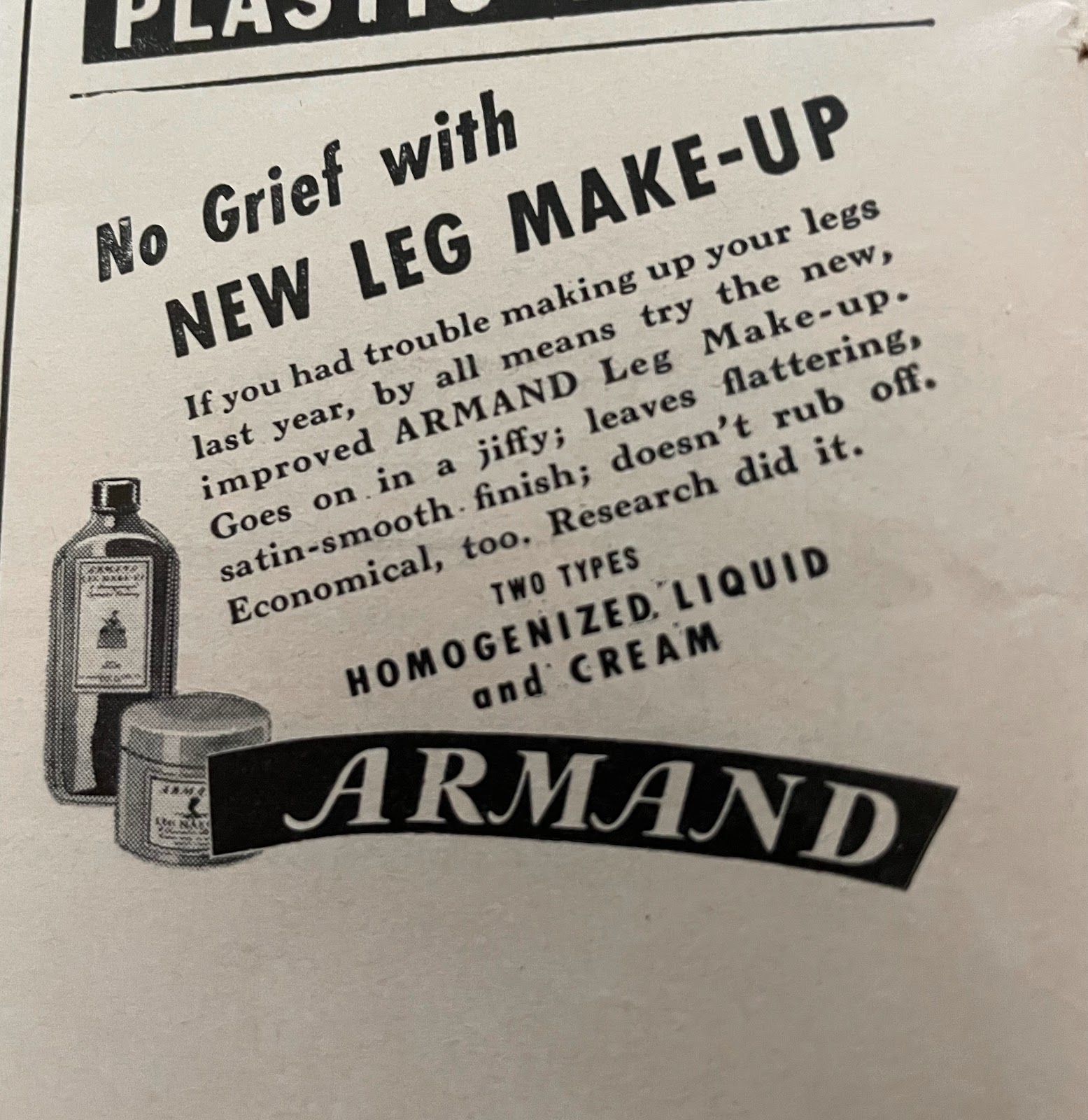
Life Magazine, April, 1943

Here’s an interesting ad from the 1943 Life magazine I’ve been perusing. While I had heard of women painting black lines on the backs of their legs to mimic stockings, I didn’t realize that skin cream would go on first. Aren’t we women lucky nowadays to just pull on some jeans? Imagine having to put make-up on your legs before heading out. No make-up could cover the goosebumps in our frigid weather. 

I’ve been working on a book focused more on my dad’s past and inevitably that leads to music and to the dance floor. My dad’s dancing days ended along with the war. But at one time, his Luftwaffe uniform made him eye-candy for young German women. My dad’s first wife was a dancer, who liked to show off her shapely legs into her old age, always in a pair of red pumps. I wish I’d asked her about the leg make-up. 

The generation who experienced the Second World War is fading fast. And so are their stories. We forget how all-invasive those years were ... even if the battles were fought in Europe, the whole world was involved. 


Wartime Ads for Coffee


Nerman’s, a local secondhand bookstore, shut its doors last month and during the weeks leading up to the final closing, I explored some of its historic treasures. It’s a good thing I live on the other end of town because I could have spent too many hours in that dusty, musty place on Osborne. As it was, I got myself a nice stack of Second World War era magazines and a few memorable Nancy Drew books. 

Perusing a now eighty-year-old April 12, 1943 Life magazine I was struck by war ads. Whether it was about women preening themselves for their soldier, use of food rations, cigarettes, alcohol, rubber or good walking shoes, the ads give a great insight to life inside the States back when a world war completely overshadowed normal life.


Just a few weeks ago I blogged about the Kaffee und Kuchen ritual in my immigrant family and friends.  Coffee, of course, is a staple in many western homes. 

Nescafé was the coffee of choice when real ‘bean’ coffee wasn’t available and all week long, my dad—an avid coffee drinker—would only drink Nescafé.  It was the go-to brand for all the adults I knew. 

During the war, Nescafé—according to this ad in the Life magazine—was not available to civilians. It was all being sent to the Armed Forces. A history of how Nescafé served armies and then civilians in occupied Europe after the war is available on the Nescafé website. 

So the next time I line up for my latte, cappuccino or Americano, I might sip with more of an appreciation of living a rather privileged, entitled and self-indulgent life. I hope that good coffee is still being poured and sipped on Ukraine’s bloody eastern front. I never want to taste my coffee without tasting the gift of peace.  Ersatz coffee, made of chicory or dandelion roots might look like coffee, but it will always be a poor substitute for the aroma and jolt of real coffee! 


Canadian Authors and Ukrainian Memories

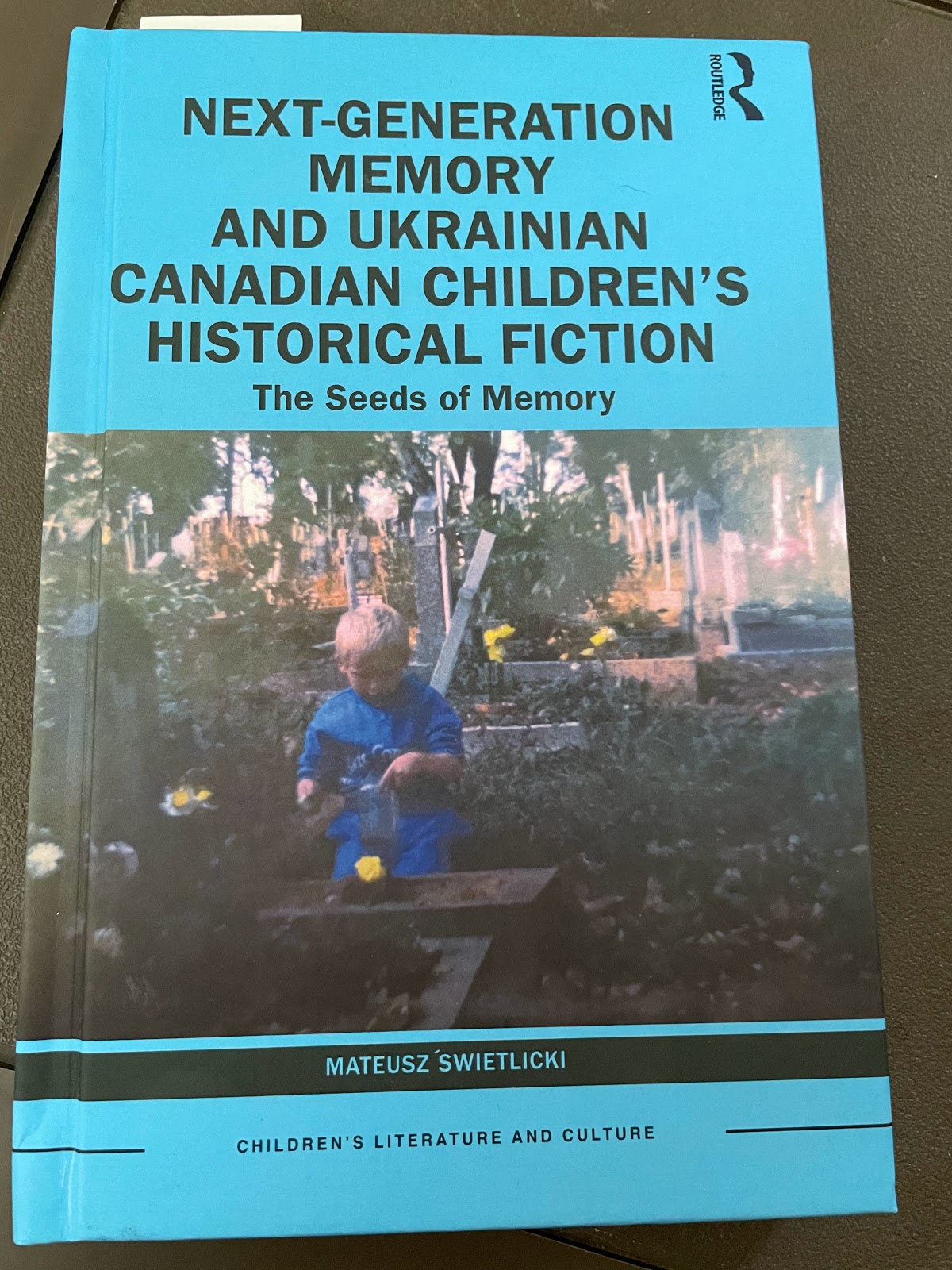
Canadian authors and Ukrainian memories come together in a new textbook released by Routledge this week. Very exciting (and scary!) to see my earlier books mentioned in a new academic release, Next- Generation Memory and Ukrainian Canadian Children’s Historical Fiction, The Seeds of Memory, by Dr. Mateusz Swietlicki, Assistant Professor of English Studies at University of Wrocław in Poland. 

Wrocław, known as Breslau until 1945, is a historic city on the Oder River in what was once known as Nieder-Silesien, or Lower Silesia. But its tranquil setting belies a violent past. Breslau, one of Hitler’s fortress cities, witnessed brutal fighting in the final months of the war. I can't help but think of today’s war and the destruction happening in Bakhmut. 

An old woman I used to visit in a local nursing home had lived in the area. In the final months of her life, as delirium took over more and more of her consciousness, she’d again be the fifteen-year-old teenager hiding in the woods of Lower Silesia, evading the Soviets, calling out to her parents. Once I sat helplessly with her for a whole hour, while she’d cry out, “Mama, wo bist du?”  (Mama, where are you?) What memories will those affected by today’s war have when they’re old?  Wars finally do end, but traumatic memories burrow deep inside a person, waiting for their chance to be relived.

Wrocław, Poland is an old University city with a youthful population. Not only is its town centre a UNESCO World Heritage site, more amazing, to me—a bookworm—is that in 2019 Wrocław was a UNESCO City of Literature.  How cool is that? I didn’t even know that they had such a thing. With a bit of googling, I discovered that Canada’s UNESCO city of literature is Quebec City, granted that privilege in 2017. What are the criteria, you ask? Check this link. 

For me, the thrill of having a textbook that refers to my mom’s story empowers me to keep researching, writing and sharing. My earlier books died premature deaths and I'm sad for that loss. The story of my mother’s kulak childhood and of collectivization was the beginning of my writing journey as I explored the source of my family’s homelessness and fracturing. Having found the story of the windmill and then losing it to unstable publishers still hurts and lesson learned! Having the kulak story mentioned in this academic text gives me courage to keep trying.

I’m grateful to this Polish academic who noticed The Kulak’s Daughter/Red Stone on Goodreads and sparked some life back into her. Even if her story’s no longer available in book form, at least there’s a conversation about her experiences of collectivization and the 1930 liquidation of the kulaks. In a world where truth is being manipulated by leaders like Putin, memories of those who lived through past atrocities matter ... more than ever.

I got my own copy of Dr. Swietlicki’s book earlier in the week and can’t wait to dive in. I’m sure I’ll be posting about it again as I peruse the other novels discussed alongside my own. 


Brain Storms

March 26th is Epilepsy Awareness Day. Three people in my immediate family have been diagnosed with the condition. All three lead normal lives—their seizures managed with medication and simple precautions to avoid triggers like flickering lights and stress (not always easy, to be sure!). Epilepsy, like near-sightedness, does not stop them from embracing life.  Such was not always the case.

Maxime Raynal (Wikipedia)

Back in the 1930s, in Nazi Germany, epilepsy was considered a disability and a disability meant forced sterilization—at the very least—and by 1939, it had the potential to be a death sentence under the Aktion T4 program. 

In Tainted Amber, I explored the impact of epilepsy on a young couple as they fell in love during the Nazi years. The Nazi ambition of a perfect society stigmatized disability and this included people with seizures. Fortunately, in 2023, 90 years after the Nuremberg Laws for the Prevention of Hereditary Disease were proclaimed, epileptics are largely integrated into our world. You might be sitting near an epileptic on the bus tomorrow, or have one teaching your kids, or cutting your hair. 

Neil Young deals with
epilepsy by avoiding crowds
Raph_PH (Wikipedia - CC)

To learn more about epilepsy, visit this website. And if you’re lucky enough to have an epileptic in your life, give them an extra hug and maybe wear purple on March 26th. Epileptics like Neil Young, Charles Dickens, and the singer Adele highlight the creativity that many people with epilepsy enjoy. Some might consider seizures a gift — a torrent of electrical activity in the brain—a true brain storm.

Manitoba has a volunteer-run advocacy group for families afffected by epilepsy.  Visit their website to learn more.  No more shame, no more stigma, no more institutionalization or sterilization. 


Kaffee und Kuchen

The ubiquitous coffee pot
I grew up around the culture of Kaffee und Kuchen. This important event usually happened on Sunday afternoons or on birthdays. It involved good, strongly brewed coffee, heavy cream (whipped, if possible) and an assortment of rich cakes, including fruit flans using whatever fruit was in season, with more whipped cream and the ever-present Streusselkuchen and Königskuchen. Other cakes might include Bienenstich, Honigkuchen or the decadent Schwarzwälderkirsch Torte. Readers of my novels might recognize the cakes and the table setting.

Perhaps it was a symptom of the after-war generation. Perhaps having survived the horrors of war, the simple pleasure of sitting around a table and gorging on food was a sort of heaven on earth. I don’t know. I do know that the coffee table Kaffeeklatsch was the highlight of the week for my parents and their fellow immigrant friends. 

Kaffee und Kuchen meant you had a home, a table, food, and people to share it with. Kaffee, after years of ground up dandelion root or ‘Ersatz’ Kaffee was a totally appreciated luxury. It might be instant coffee with canned evaporated milk during the week, but for the Kaffee und Kuchen sessions, it had to be freshly ground ‘real’ coffee. 

Embroidered by my parents while on 
immigration ship in 1953 on Beaverbrae 
The table itself was not merely a flat platform on four legs. It was a stage showcasing a woman’s talents—starting with the tablecloth. I remember tablecloths elaborately embroidered with floral motifs and crocheted lace along the edges. I remember the handmade coasters, the crocheted cozy for the porcelain coffee pot, and the carefully chosen serviettes … often mismatched … but each uniquely beautiful. 

Then there were the dishes. Dishes for my mother and the women of her generation were status symbols like cars were for the men.  As a kid, I had my own favourite china teacup set from Mom's Sammeltassen collection. I felt surprisingly sad when that teacup disappeared in the shuffle of her final move. And yes, the teacups were for sipping coffee. 

I’m not sure if Kaffee und Kuchen culture is still going strong over in Germany. Here in Canada, as the war survivors pass away, many of their traditions are fading with them. But I have the porcelain coffee server to remind me. It's not all that useful anymore. But when I smell the aroma of freshly brewed coffee, I can often hear the Kaffee Klatsch ... as the survivors of war, homelessness, gulags and immigration indulge in the freedom of Sunday afternoon peace. 


Recent Posts

Writer's News

I’m darn happy to share a bit of my writerly journey on a podcast, ‘ A Writer’s Life ’ hosted by the gracious and fabulous host, Heige Boehm...