Refugees

I grew up in a German immigrant family that carried a lot of silent guilt. Guilt can be heavy, messy and complicated. Small wonder that religion was so important.
                 
The word refugee was a common term in our house. The German word is Flüchtling (literally meaning: person in flight). Growing up, there were two kinds of Germans…the Reichsdeutsche (someone from Germany proper—they had status) and the Flüchtlinge (this word had a condescending feel to it). These were my childhood impressions.

The word “Reich” literally means ‘kingdom’ or ‘empire’ as in Hitler’s Third Reich. The Third Reich, was an attempt to rebuild after the failed “Second Reich,” (formed in 1871 under Bismarck with the unification of the German states) and ending with the German defeat in 1918. (The First German Reich was the Holy Roman Empire from 962-1806.)
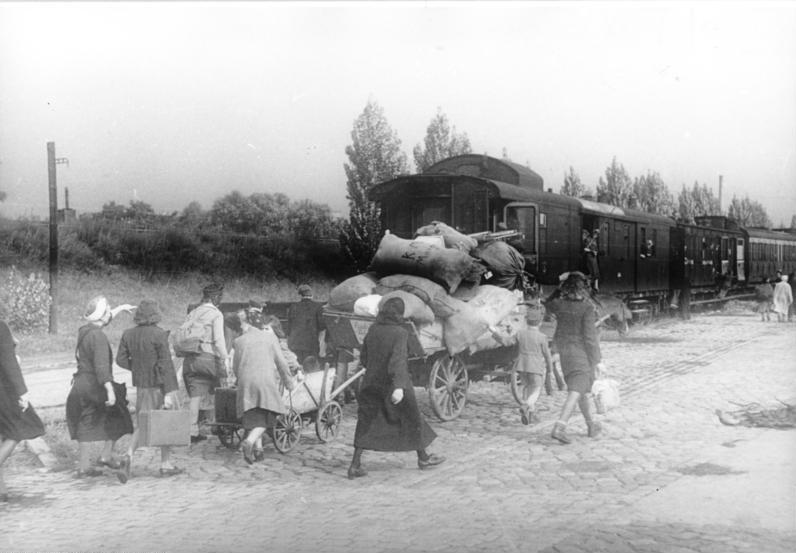
My dad was a Reichs German and my mom was a Flüchtling. As a child, I confused ‘Reich’ with ‘reich.’ The noun and the adjective. To be ‘reich’ means to be rich. And this certainly was the case. The Reichs Deutsche might have had bombed out homes, but they still had homes. The Flüchtlinge had to flee their homes, their farms and their villages. They had literally nothing—not even photos, and few documents. For example, my mom had no birth certificate.   

There’s another term synonymous with the Flüchtlinge of my growing up years: Volks-deutsche. A Volk-German is an ethnic German living outside of the Reich. There were substantial German populations throughout Europe: Poland, Czechoslovakia, Hungary, Romania, Soviet Union, Lithuania, etc. In most cases, these people had been living peacefully side-by-side with the locals for centuries.  Hitler changed all that with his push for Lebensraum. When the war ended, the Allies determined that the best way to solve the German problem was to force all ethnic Germans into Germany proper. And that’s what happened.

Moving between twelve and fourteen million people (mostly women, children and elderly) identified as German between 1945 and 1950 became the largest ‘ethnic cleansing’ in history. It happened at a time when resources for the whole continent were limited. No country had extra food for millions of homeless, needy people. Consequently, it was an expulsion with horrific suffering. Because the ethnic Germans had benefited under the Third Reich there was little sympathy for their subsequent plight. Whether they were babes in arms or bedridden elderly, they were German and therefore they had to pay for the crimes of the Nazis.

It’s because of this guilt that their stories have been hushed. I’m not trying to judge the morality of this. Rather, I’m trying to understand the experiences of my family.  All of Europe was a quagmire of suffering throughout the forties. I’m exploring this ugly time of humanity because it had a such a major impact on my immediate family. Nobody would or could explain their stories to me while I was a kid growing up in the suburbs of Winnipeg.  

Image result for orderly and humaneHistory books never gave more than a few passing references to the expulsions. That’s why I devoured R. M. Douglas’s book, with the ironic title: Orderly and Humane: The Expulsion of the Germans after the Second World War.  It finally gave me a sense of perspective—gave voice to the guilty silence. It also helped me to understand the difference between the Flüchtlinge who were fleeing the Soviet advance in the winter of ’45 and the people displaced because of a desire for revenge. These people were forced to leave their homes, detained in transition camps and finally shoved into overcrowded freight trains and dumped into a bombed-out Germany.  The country obviously had no resources to absorb the millions of newcomers. The Allies supervised this ethnic cleansing, while Nazi leaders were being tried for the same crimes.

Politics matter. Let's make sure we don't vote for leaders who have hostile intentions against our neighbours.

Refugees are flooding Europe today—more than six million Syrians seek new homes. They will need to tell their stories, too and we must listen because it’s through story that we heal.

Top photo attribution: Bundesarchiv, Bild 183-1983-0422-315 / Donath, Otto / CC-BY-SA 3.0

Adoption Memoirs


Children, Elderly, Families, Hand, HeartI finished reading Detachment, An Adoption Memoir, by Maurice Mierau last night. Good book. I’ve read another adoption memoir, To Sing Frogs, by an American who adopts three children from eastern Russia. Both authors refer to the difficulties that orphans have attaching to their new families.  In the American book, the author John Simmons, calls it Reactive Attachment Disorder. Children are afraid to connect with loving parents because they can’t “handle the pain of the inevitable if [they] became too committed in the relationship.”   Mierau refers to it, too, after he goes to see a psychologist because of the older boy’s problems in school.  “...it was common with kids who were adopted or in foster homes, and who’d experienced severe neglect or child abuse.”  

I found both books fascinating, but Mierau wins in the literary style department. The Simmons book was a re-telling of an international adoption. The Mierau book is a muse about life. It’s self-reflecting, egoistical even— not really focused on adoption or on the children—as much as on a man struggling to find his identity as a son, a husband, a father, and also as a writer. He doesn’t always present himself in the most favorable light. This takes courage and for that I admire him even when, at times, I disliked his actions. His poetic language and raw, unflinching honesty makes this book a compelling memoir. Here’s my favorite line:  “There was a certain slant of light on this summer afternoon that made me believe, for a moment, in the eternal.”   

Mennonite Heritage Village


I spent Victoria Day Monday out in Steinbach at the Mennonite Heritage Village—a perfect way to enjoy a warm May afternoon. It's less than an hour's drive away from Winnipeg. Upon arrival we were transplanted to another time. And since I love history, I was as happy as a duck in water. We started with the indoor exhibit which featured maps, photographs and background information about the Mennonite migrations.  I was especially interested in the artifacts that pertained to the children and women and to any Soviet connections. The Russian Mennonite story is similar to the Volhynian Germans.  More than 20,000 Mennonites came from Russia during the 1920s and thousands more came after the Second World War. 

The Mennonites have always placed much importance on family and on education. There were clothes, books, school supplies and even hundred-year-old toys on display. A couple of dolls reminded me of the clay-headed doll with the soft body that I crafted last month with my Russian instructor. 

Clay was also the building material for a sod hut, called a Semlin, built by early settlers for their temporary lodgings. We got to walk through one with a particularly tragic story attached to it. Severe weather and disease took its toll on early settlers. We have much to be grateful for—homes with central heating, plenty of easily obtained food, along with advances in medicine and technology.

This village is sort of the Mennonite equivalent to Lower Fort Gary (built by the Hudson's Bay Company)—minus the fortifications. Perhaps Mennonites used their faith as a shield, rather than walls of stone. They are well-known pacifists. Many immigrated to Manitoba from Russia to avoid the draft. Their thriving communities are a testament to the strength of peace.  

Back to the tour. On this particular day—tulips, lilacs and picture-perfect geraniums added to the quaint domesticity of the village. A shy young donkey refused to bray for me. But the lambs bleated and goat kids were eager for pets from human kids. Beautiful, strong horses trotted by proudly pulling a carriage load of visitors.

For me, the centre point of the village is its beautiful windmill. I couldn’t help but think of my own grandfather’s windmill—broken by communism and hate—during the anti-kulak campaign under Stalin.  Climbing up the innards of this windmill I imagined my mother seeking shelter in the windmill during a storm. The only thing missing were the storks.


Anyone looking for a day trip out of Winnipeg—consider exploring the Mennonite Heritage Museum. It’s educational and fun for all ages.  You don’t even need to bring lunch. There’s a restaurant and lots of traditional farm cooking available.  And, you don’t even have to be Mennonite to enjoy it.   


Art echoes History


Beautiful time of year. I'm sitting in my garden surrounded by the energy of new growth. But what was May like back in 1945?  I’m researching another novel and re-confirming that when the Second World War ended, everybody didn’t just pack up their war toys and go home. For some, like my mom, there was no home and any blossoms reflected only a cruel irony.

Back in old East Prussia, Hitler had retreated from the Wolfschanze (Wolf’s Lair) his eastern war headquarters and the bunkers were blown up in January, '45 just before the Soviets arrived. (The Wolfschanze is where Stauffenberg attempted to assassinate Hitler back in July of  '44.) 

While Hitler made his getaway, my mom and millions like her, were ordered to stay put. Any attempt to retreat west was viewed as treason. And so the East Prussians celebrated a final Christmas in their homes before the biggest offensive ever assembled began on January 12th.  The Nazis had focused their troops on the Western front and completely underestimated Stalin’s forces. They were now outnumbered: 250, 000 Soviets vs. 30,000 Germans.

But it was more than just the numbers that spelled defeat. The Soviets were fired up with revenge, while the German soldiers were tired and discouraged.  Nazi atrocities were beyond despicable and soon it would be the German women, children and elderly who would bare the brunt of the Soviet wrath.

So by May of 1945, Hitler was dead, the Wehrmacht was kaput and there was no one left to defend the defenseless. May, 1945 in East Prussia was a cruel spring—crueler than any indecisive weather of April could ever be. Rape, hunger and disease flourished alongside the linden and chestnut blossoms.

I’ve just finished re-reading “A Terrible Revenge” by Alfred-Maurice de Zayas. It’s filled with memories similar to conversations I've shared with older Canadians of Eastern European origin—survivors of that revenge. They were children and teenagers during that ugly spring ending the war. Now that they’re old, horrific memories leak out and I want to hear them—before they all get lost by the power of time.  Eleven million Germans were displaced after the war. Many came to Canada to start over...to forget.  And then these darn writer types start asking questions.  What does it mean to lose your home? Maybe the people in Ft. McMurray know.  I can only imagine.  

The fact that a song about a 1944 atrocity can win the 2016 Eurovision Song Contest proves that our histories continue to be relevant even on this beautiful spring day. Art echoes history. We can listen, read, and grow wiser. Or not. It's our choice. We always have a choice. 


Meet Katya!


May I introduce you to Katya—the doll—attached to her own little doll, Nadya.  Katya is the protagonist of both Red Stone and Broken Stone.  
The  doll workshop at the Forum Art Centre was so much fun. Can't understand why it wasn't sold out.  I think I'll use my leftover clay and try to make Zenta, Katya's shaggy black and white sheep dog. I'll see how that goes without the help of Helen my talented and inspiring instructor. (Helen, coincidentally is from Russia and has just survived her first Winnipeg winter!)  Here's my co-doll-maker, Judy, with her creation...an awesome weathered-looking gardener complete with shovel and a recycled letter carrier jacket. 

This morning I decided that Katya was still missing something and so I scrummaged around and found an old lace-edged handkerchief. It works perfect for her apron and kerchief, plus, the edging was crocheted by my mom or one of her sisters.

This is the first time I've ever tried something like this. For me character study always involved words. Now I've learned a teeny bit about character from an artist's perspective. The head, feet and hands are sculpted from clay, while the rest of the body is stuffed. This means Katya needs a stand to support herself which Helen's husband kindly offered to build for her. (Barbie can't stand on her own either.)

This Katya doll will accompany me on book signings. You can meet her in person at the Millennium Library on May 7th, at the Local Author Fair. 

Dolls


I’m excited about a doll-making workshop I’m attending this Saturday.  Why would an adult like me—with grown children (and no grandchildren)—be interested in making a doll? I’m not really sure. Maybe it’s about connecting to my inner child. Or maybe it’s about connecting to my mother’s inner child. I’ve been quite focused on my mom’s childhood over the last ten years and the doll theme keeps recurring. (My character, Katya, in Red Stone has a disturbing relationship with a doll.) I find the concept of dolls and our connection to them fascinating.

Back when I was six or seven I remember sitting for a photo shoot. I think there were twenty-two dolls lined up around me. And yet none of them seemed special. They were all just part of a collection—my menagerie of dolls—with me in the middle.

A few years later I received a huge walking doll who’d wear my own toddler dresses. She too remained nameless. My mother seemed more enamored with her than I ever was. When I was ten and my parents were having a new house built, it was this doll that moved in before the rest of us. I put her into my future bedroom and she stayed there all alone until I finally moved in some months later. I don’t remember having an emotional connection to her. She was stiff and formal. Too nice to be a real friend. My mother saved this doll and gave it to my own daughters. She had a rough time in our house. Not enough respect and a dog who liked to chew. When she finally passed on, I was glad to be rid of her.

What I’d dearly wanted as a child, was a Cabbage Patch doll. Something I could cuddle and hug. Something that wouldn’t poke me with a stiff plastic arm in the middle of the night. But my mother disapproved of rag dolls. I’m not sure why. She called them wobbly. True. They were flabby and limp like the white bread I never got to eat in my school sandwiches. We were Germans who only ate hard, rye bread.  Instead, my well-intentioned parents got me a new baby doll that was just as hard and stiff as my unloved walking doll. This doll did have a little hole in its rosebud mouth and I would bottle-feed it water and let it wear tissue diapers. I don’t recall trying to feed it real milk, but I do remember making Pablum and pretending to feed her while spooning it into myself instead.

I knew my doll playing years were coming to an end when I started junior high. But it had taken me until then to convince my parents of my need for a Barbie doll. So at an age when my friends were snubbing their adolescent noses at doll-playing, I was just getting serious. Luckily I found a kindred soul and we’d meet on weekends and play dolls for hours upon hours.  In secret.

I didn’t have a real Barbie made by Mattel. I had her poor cousin, Mitzi, made by Reliable.  Instead of a long golden ponytail, Mitzi had a head of red curls. But she could wear anything that Barbie wore. My parents wouldn’t spend the money that a real Barbie cost. (Same thing with jeans. I never got real jeans—Lees or Levis—until I was old enough to buy my own.) Still, Mitzi (even without the proper pedigree) lived a full, dramatic life during my middle grade years. My friend and I would create incredible worlds for our young women dolls.  I’d borrow my brother’s GI Joe doll —a hunk of a man (plus, he had bendable hands)—while my friend had a Skipper with beautiful long, straight hair, and a Ken-like Allan doll. We had such fun with our homemade doll furniture, clothes, and wild imaginations.

Another type of doll I remember playing with were paper dolls. We’d make our own. These, like the Barbie-types, had beautiful clothes that we’d design with crayons or pencil crayons. I can still visualize some of the gowns I created. The beauty of paper dolls was that they didn’t take up much room and cost next to nothing to make.

We crafted elaborate stories for our young adult dolls—love stories, mysteries—complicated plots filled with intrigue. I never realized until now that these dolls were more than toys.  They were characters of unwritten novels.

So when I go to my doll workshop this weekend, I’ll truly be re-connecting with my inner child. Oh the places we’ll go! 

Clutter or Compost?


There’s been a lot of talk about clutter lately. The talk goes something like this: Clutter weighs you down. Clutter leads to hoarding. Clutter is bad. I look around my desk, around my writing area and examine my clutter. There’s the photo of my kids back when they were kids...twenty some years ago. There’s the photo of my dead pets...no longer demanding to be fed, or walked. There’s the big rock from Hecla, the red rock from Ukraine, and the pile of rocks from other beaches. There’s the matryoshka erasers that my daughter got me.  There’s the now two-year-old Happy Retirement sign. 

More photos plaster the walls...me with an old woman in Federofka, another of my mom with my youngest daughter, soccer shots of my son, drawings by my current science students, a red poppy oil painting by my dad.  An old pole lamp, which should possibly go in the trash, but it comes from my parents’ rec room and reminds me of being a teenager downstairs, listening to old records. Newspaper clippings, quotes and a smattering of passwords dot my bulletin board like dandelions on a lawn. I could go on and on. My office, my ‘room of one’s own’, is a true compost heap of memories, dreams and meanderings. It’s where I do my writing and it’s as cluttered as my mind. 

Compost, Garden, Waste, Bio, Nature, Garden HelpersA writer is a great recycler, re-user and in the end...reducer. We recycle a jumble of moments and emotions into narrative. We reduce the compost pile of life into story. My ‘room of one’s own’ will never look like a hotel room and that’s okay. I’m a writer, I roll around in clutter like a happy pig. And with that pleasant image, I must turn to some revising...or maybe re-composting. 

Recent Posts

Writer's News

I’m darn happy to share a bit of my writerly journey on a podcast, ‘ A Writer’s Life ’ hosted by the gracious and fabulous host, Heige Boehm...