One Year


It’s been a year since my novel, Crow Stone, was released. I still pinch myself that a story I carried with me since childhood has actually become a book. Turning my mom's confused memories into a narrative helped me appreciate the community of displaced people who enveloped my childhood.

While not topping bestseller lists, Crow Stone’s release, released me from the weight of my mother’s trauma ... a trauma that stayed with her until she died at age 92 ... still paranoid, but also resilient and clever.

Thank you again ...

- for support from my Canadian publisher, Ronsdale Press, even as they transitioned to new owners. 

-  for positive reviews from Kirkus, Booklist, Canadian Materials Review and more. 

- for the book’s travels to the Frankfurt and London Book Fairs.

- for the attention from Dr. Mateusz Swietlicki, East European professor from Wroclaw, Poland.

- for German podcast listeners who got to hear me interviewed.

I’m grateful to you for sticking with me on my meanderings. My new projects … immigrant stories – one for adults and one for middle grade—are looking for homes. Traditional publishing is a challenging and crowded field.  More people are writing, less people are reading. 

I keep reminding myself ... it's a journey, not a destination. 


Picking Favourites—Not Fair!

Shepherd, an online database of books connecting readers, authors, and their books by theme asked contributors to select their favourite books of the year. Not fair! Almost every book I read is a true treasure and I appreciate and respect the writer and their need to tell a story. 

That said, much of my reading these past few years, has focused on the history of Ukraine, Russia, Germany, and Second World War history.  Violence involving the former USSR continues to create headline news as the ‘special military operation’ grinds on into a second year with no end in sight. War and death dominate our news and Canada is flooded with  21st century war refugees. 

The authors of my three book choices include:  Erin Litteken, an American novelist writing for adults. Marsha Skrypuch, a Canadian novelist writing for middle grade, and Mateusz Swietlicki, a Polish academic, specializing in East European studies.  To find out about the books I chose, visit Shepherd. https://shepherd.com/bboy/2023/f/gabriele-goldstone.

It’s empowering to know that the experiences of our families, hidden for decades because of war, immigration and even shame, are being explored via the power of literature. These are excellent books, targeted at a variety of readers,  about a history that still matters. 

Thank you to the folks at Shepherd for making it so much easier to follow topics of interest. I recommend them to fellow authors, readers and teachers. A great resource!

Check out their website for favourite reads of almost 1000 authors. And if you're an author, you might want to join their growing list. 


Pumpkin Talk

I shared an interesting conversation this week with my EAL student, (I’ll call her Olga) a recent arrival from Ukraine. We discussed the North American celebration of Halloween. None of the students I’ve worked with, from South Korea, China, Iran and several now from Ukraine, are comfortable with our infatuation of scary. The immigrant church community where I grew up wasn’t too happy with Hallowe’en either.  (Halloween or Hallowe’en comes from Hallowed Eve, the night before All Saints’ Day).

For young Canadians, Hallowe’en is about pumpkin carving, fake graveyards on suburban lawns, ghost sheets blowing in the wind and candy—lots of candy. Us older folks like scaring ourselves with a good ghost story or movie. Halloween frights equal the adrenaline rush of a roller coaster ride. Nothing more. 

During our conversation, Olga and I looked at Halloween traditions around the world. In Mexico, the holiday takes place over two days and family graves are lit up with candles. I learned that in Ukraine, cemeteries are visited the week after Easter and food is left behind to nourish their souls. Here in Canada, we have no special holiday for the dead.  Not even a day off work. Just an evening where kids get to dress up and go begging for candy throughout their neighbourhood. We laugh at scary.

Meanwhile in Russia, they’re snubbing anything Western. This year, they have their own version of Halloween and call it Pumpkin Saviour’s Day


Art Above Politics, Love Above War


Several years ago, I met Helen, a newcomer from Russia, at Bev Morton’s Wayne Arthur gallery here in Winnipeg. (Bev sadly passed away in Nov/21).  Helen’s art was as captivating as her warm personality. As a newcomer to Canada, she was eager to be accepted in our culture using her art as a universal language. During one of her doll workshops, I got to know her better while creating my little ‘kulak’ doll. 

Unfortunately, Canada is home to many a starving artist.  Becoming financially independent as an artist is a huge challenge for locals as well as new residents. My Russian friend struggled to make the proper connections but money was always tight. Disappointed, she finally returned back to Russia, her Canadian husband, Ed, in tow.  

Helen and Ed created a home for themselves—and for Helen's art—outside of Togliatty (known for its Lada cars) in the Samara Oblast. 


My Katya doll


Before Helen left Canada, she and I had collaborated on a picture book. Time was short and the project shelved until late 2021. Finally, in January, 2022 we focused time online working on the details. Helen was determined to make this happen and I admired her tenacity. Then in February 24, 2022 Russia invaded Ukraine and our book project was again stalled.


Kudos to Helen for believing in the power of family, of friendship and of art, for finishing up this story project. I wrote the English text, Helen supplied the Russian translation and created the art, the layout and the final production. She launched the book at her gallery in Samara earlier this fall. Perhaps someday I’ll be able to visit Togliatty on the Volga River and together we can spread the message that just because people are different, doesn’t mean we can’t still love and support each other.

Someday this war will end and we can return to feathering our nests instead of destroying them. And someday, I will have this book about storks and cuckoos produced for distribution in Canada. 


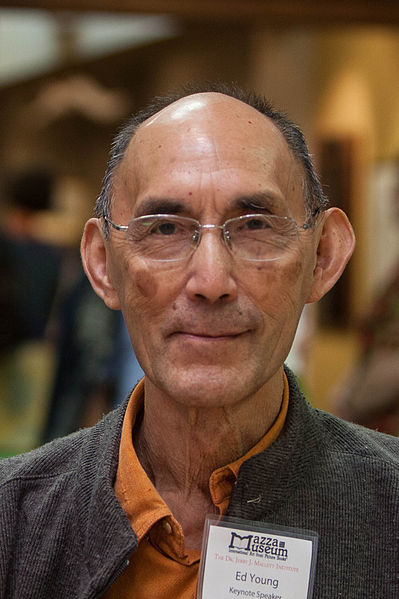
Remembering Ed Young and his Seven Blind Mice


The author of possibly my favourite children’s picture book has died. Ed Tse-chun Young both wrote and illustrated Caldecott-award-winner, Seven Blind Mice (1992). The inspiration for the book came from an Indian fable known as “The Blind Men and the Elephant.”  

CC Alvintrusty

Young received an earlier Caldecott medal in 1990, for his picture book, Lon Po Po. (A re-telling of the Chinese Red Riding Hood).  Born in 1931, he was raised in China, a culture which influenced most of his picture books. Young is quoted as saying:

“A Chinese painting is often accompanied by words … they are complementary. There are things that words do that pictures never can, and likewise, there are images that words can never describe." 

He moved to the USA when he was 19 and studied art, receiving many awards for his picture books ...

 ... stories that focus on Chinese and Indigenous folktales and I loved sharing them with my children when they were young. Over the years, it's the wisdom of Seven Blind Mice and its stark images that has stayed with me. 

The collage artwork in Seven Blind Mice, is featured on solid black.  Kirkus Reviews said, “Exquisitely crafted: a simple, gracefully honed text, an appealing story, real but unobtrusive values and levels of meaning, and outstanding illustrations and design--all add up to a perfect book.” (1992)

Compare this to a Kirkus review of an early Ed Young book, Up a Tree, where the reviewer writes, “A negligible idea occupying a very few pages--to be no sooner seen than forgotten.”  (1983) Ouch! Good thing Mr. Young didn’t let such a negative review stop him. 

Ed Young’s mice have been my role models. Sharing other points of view lets us grow wiser. I’m grateful for his art, his vision and his stories. 


Hoarding Issues

I heard a fascinating podcast which featured Nan Turner’s new book, Clothing Goes to War, discussing the shortage of fabric during the Second World War. Reducing, reusing & recycling was the norm. Fabric was expensive and clothes were usually sewn at home.  Not only was cloth in short supply, but so was rubber and metal which affected elastics, zippers and the always necessary, women’s girdle. We all know about the nylon shortage and the leg make-up, and eyebrow pencil back seams. 

During my childhood, Mom threw nothing out. Everything had a use. Snippets of elastic could hold up worn out knee highs, zippers were torn out of old sweaters and used in new sweaters. The new sweaters, of course, were made from the unraveled old sweater. I still have a clothespin bag made of a corduroy vest my mom wore back in 1950, with an ancient zipper torn out from a skirt.  (It’s no coincidence that the sub-title of Nan Turner’s new books is, “Creativity inspired by Scarcity in World War II.”)  

As that war generation dies, we’re now cleaning up their leftovers. Sometimes their closets, like their stories, are jammed full of stuff we want to ignore or throw out. Some of it truly is tired old junk. 

A friend of mine is currently dealing with her 98 year-old-mother’s hoarding. It can become a disease … a thriftiness that results in isolation and paranoia. But back when she lived in Schlesien or Silesia (now western Poland), during the war … during the formative years of her life … hoarding meant survival.  

Advertisers, in magazines like Life, always mentioned thrift and supporting the war effort. But they also offered hope for the future, when there would be new clothes. 


Come and See

Saw the re-mastered movie, Come and See, last week at Cinematheque a small, boutique-style theatre that showcases independent and international films here in our Exchange Distract.  It came out originally in 1985. 

Come and See is set in the forests of Belarus, in 1943, and focuses on the partisan movement. Some might consider the film a horror show, but it was in fact a war movie. It depicted animal cruelty, rape and violent death on the eastern front during the Second World War. According to the closing moments of the film, 628 Belarus villages were burned to the ground by the Nazis. Similar burnings happened in Ukraine. It’s no wonder a Ukrainian woman once spit in my face when I talked with survivors of such atrocities. I heard of how women and children were separated from the men, herded into barns and set ablaze. 

I searched the internet for some stats on Ukrainian losses and found this: “... the world never heard about the Ukrainian village of Kortelisy which the Germans burned to the ground on September 23, 1942 and killed all its 2,892 population of men, women and children. There were about 459 villages in Ukraine completely destroyed with all or part of their population by the German Army with 97 in Volhynia Province, 32 in Zhitomir province, 21 in Chernihiv province, 17 in Kiev province and elsewhere. There were at least 27 Ukrainian villages in which every man, woman and child was killed and the village completely destroyed by the Germans. (Ukrainska RSR u Velykyi Vitchyznianiy Viyni, vol.3, p. 150). http://www.infoukes.com/history/ww2/page-20.html

public domain, Stanislaviv, October, 1941
My father was sent to the eastern front in October, 1944. He never talked much about it — focusing his war memories on his earlier time in the Luftwaffe, until he crashed. I think his new position in the Military Police was to discipline the failing moral of the Wehrmacht. I know that he drove a motorcycle with a sidecar … like a Nazi in the movie. I felt quite uncomfortable watching those scenes, along with the others where the Nazis drink, loot, shoot, rape and sing. The father I grew up with liked to go fishing and hunting. He liked to build things and read books. He built model Junker airplanes with my brother.  So excuse my obsession with that old war.  It forms part of my identity.
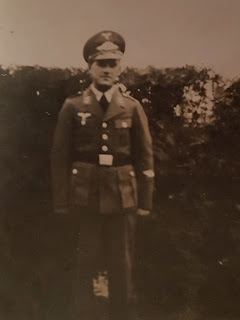
my dad, 1944

Last week our parliament honoured a 98-year-old Ukrainian-Canadian, Yaroslav Hunka, who had supported the Nazis in Ukraine. Canada cringes with the political fallout and Poland demands his extradition. It would be fascinating to hear Hunka’s story. Why are we so eager to seek revenge on something that can never be revenged? Hunka would have been 20 years old at the end of the war. He would have grown up under Stalin’s Five-Year Plans, experienced the Holodomor. He might have seen the Nazis as liberators from the Soviets. He might have had to choose between two evils. Until we hear his story, we might hold off on judging him. 

The film, Come and See, depicted the horrors of Nazi atrocities with gut-wrenching visuals. If 18-year-old Hunka played a role in those events he does not deserve honour. But neither does he deserve my judgement. I can only be curious. What's his story? 


Recent Posts

Writer's News

I’m darn happy to share a bit of my writerly journey on a podcast, ‘ A Writer’s Life ’ hosted by the gracious and fabulous host, Heige Boehm...