The Power of Chocolate

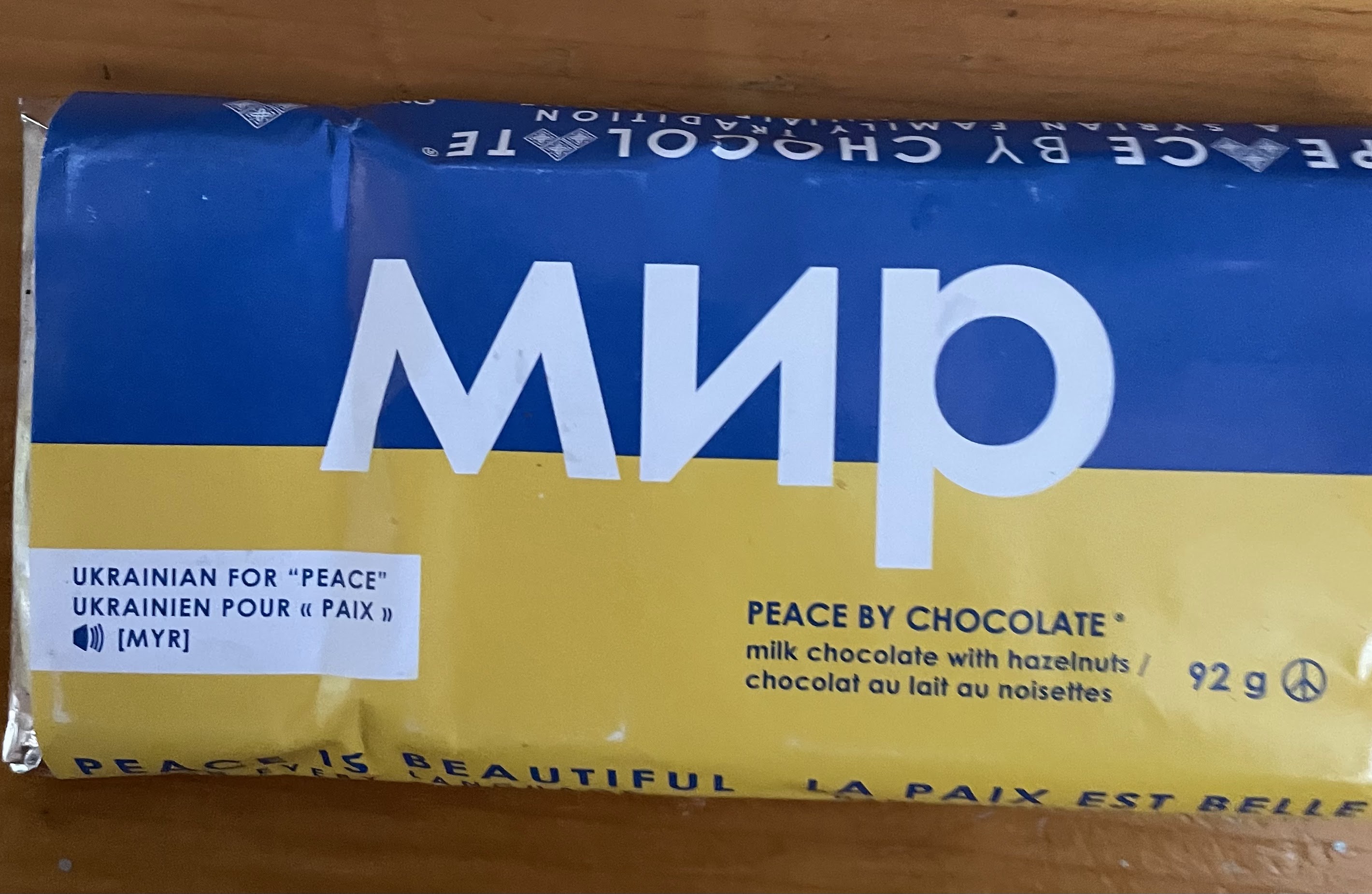
While visiting what was probably the last open-air farmer’s market of the season, I purchased a ‘peace by chocolate’ chocolate bar, designed with the colours of Ukraine’s flag. МИР it read or 'Ukrainian for Peace' and PEACE IS BEAUTIFUL in every language.  What a simple message sprawled in big letters on a hazelnut milk chocolate bar.  And yet so political!  Ukraine wants peace.

As I indulged in my guilty pleasure, I continued to peruse the package it came in. On the back, it read, “One PEACE won’t hurt.” Well one piece is never enough but more peace couldn’t hurt either. And then I did what every curious, chocolate-indulging writer raised on Nancy Drew would do … I followed up with some research. 

Peace by Chocolate is a “Syrian Family Tradition.” The family behind this chocolate venture were Syrian refugees who came to Canada in 2012. You can check out their website and the beautiful people behind this chocolate for peace effort. The family came from Damascus and settled in Nova Scotia. It’s a wonderful immigrant success story and during this most volatile and violent of times, it’s a great reason to eat chocolate. Hopefully, ‘peace by chocolate’ during these polarizing times, won't cause too much weight gain or cavities. 

My first book, The Kulak’s Daughter (aka Red Stone) revealed the power of chocolate while out in a desolate transition camp in Yaya, Siberia. In one scene an OGPU guard takes pity on the kulak children and offers them chocolate. 

In Crow Stone, another guard (the OGPU morphed into the NKVD) shares chocolate with Katya, who’s now a prisoner of war. Here’s a snippet from the book: 

    “Eyes closed, I let the sweet dark square melt in my mouth as I remember how more than ten years ago, a guard named Sepp gave my little brother a piece of kindness. That chocolate is still melting, still spreading its goodness around.” (p. 174).

Eating chocolate is good, but giving chocolate is even kinder. We need the peace of chocolate more than ever. 

P.S. I didn't know until 2 days later, but October 28th was World Chocolate Day! Another reason to indulge. 


Remembering October, 1944

Bundesarchiv_Bild_1011-464-0383I-26,
Nemmersdorf (Ostpreußen)
October 21, 1944. It's the 88th anniversary of the Nemmersdorf massacre and the invasion has never been more relevant to modern times. This brutal Soviet intrusion on an eastern village in East Prussia marked the beginning of the end for East Prussia. (The Third Reich was doomed a long time before that.) What marked this particular attack was not only the extreme violence (too horrid to specify) but also how it was used by the Nazis. Goebbels immediately sent out a film crew and showed the reel as a propaganda trailer before German cinema features. The message was clear. Be afraid, be very afraid … the Soviets are ruthless barbarians. 

But instilling fear into the broken German population and the demoralized Nazi troops was not enough to stop the revenge-seeking Red Army. October 21, 1944, Nemmersdorf was just an appetizer of what was to come three months later, when the full assault began on January 24, 1945.

Bundesarchiv_Bild_101I-464-0384I-38,_
Nemmersdorf_(Ostpreußen),

Present-day Nemmersdorf is in the south eastern part of the Kaliningrad Oblast and known as Mayakovskoye. Located on the Angrapa River, it's a quiet place with a population of less than one thousand. Any surviving Germans were expelled or fled, as in the rest of the former East Prussia. 

Instagram is full of images of the ruins in Kaliningrad. Those beautiful ruins began crumbling back in 1944 ... a poignant reminder of war and destruction. 

Hearing about the violence and torture happening now, in occupied Ukraine, in October, 2022 just a few hundred kilometers east of Nemmersdorf ... seems unreal ... like a nightmare. Young men turned into monsters, humiliating their peers to avoid being humiliated. How did this all happen? 

I didn’t want to blog about war and violence today. I wanted to blog about something positive and good. I wanted to write about chocolate. Next week. 


Politics and Music in Russia

I jumped at the opportunity to attend a concert last weekend ...

when I heard that it would be Shostakovich’s Tenth Symphony.

Having read Symphony for the City of the Dead by M. T. Anderson last winter, I’d gained some insight and curiousity about Shostakovich’s music and even streamed some of it to enjoy during my nightly dog walks. Anderson’s book highlights the composer’s experiences during the terrible siege and I found the Novorossiysk Chimes (The Fires of Eternal Glory, Op 111b) short and accessible for a non-classical mind like mine. 

Listening to his Tenth Symphony, first performed December 17th, 1953 in what was then Leningrad (now St. Petersburg) opened my ears to what an immersive classical music experience can be. I couldn’t help but try to imagine the original audience. Leningrad was, after all, the city that endured horrendous suffering during the almost 900 days siege. 

Composer featured on Russian stamp 

A quote by the composer (the validity questioned by some biographers), says, “I did depict Stalin in my next symphony, the Tenth. I wrote it right after Stalin's death and no one has yet guessed what the symphony is about. It's about Stalin and the Stalin years. The second part, the scherzo, is a musical portrait of Stalin, roughly speaking. Of course, there are many other things in it, but that's the basis." (From the book, Testimony by Solomon Volkov). 

Even a great musician like Shastakovich had a shaky relationship with the Kremlin, as did everyone who experienced the perilous 30s and 40s in the Soviet Union. It was too easy to end up in some gulag or dead, like my grandfather during the 1937/38 Great Purges

Symphony No. 10 in E Minor, Op. 93.  Who knew that a symphony could be so political? 


Historical Fiction Favourites

I’m preparing for my part for an upcoming online panel talk, Making History Come Alive, being hosted by publisher, Ronsdale Press from Vancouver, BC. Anyone who reads my blog knows what inspires me to write and where my stories are set is no surprise either. 


I’ve been mulling over things from a reader’s point of view. Why does history matter? More specifically, why should today’s young people read about yesterday’s mess-ups? Aren’t there enough current issues demanding attention? Isn’t concern for the future a more valid interest to pursue? 

The best historical fiction allows readers to step into a writer’s characters and experience history for themselves. It offers a character, a plot and a resolution. It offers the reader something to take into the present and then to the future.

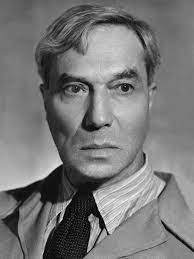
Boris Pasternak

My favourite pieces of historical fiction? For the adult in me … always, there’ll be Dr. Zhivago by Boris Pasternak. Always there’ll be Heinrich Böll. In fact, I must search out his books (devoured as a university student) and re-read them. Always, there’s Aleksandr Solzhenitsyn. How will these books stand up after all these years? So much has been revealed. So much is still changing.

For my young adult self?  Always, there’s Markus Zuzak’s The Book Thief. Always, there’ll be Between Shades of Gray by Ruta Sepetys. More recently, there’s a whole series of Martha Skrypuch’s middle grade novels. I’m about to open her most recent novel, Winterkill, set in Ukraine during the Holodomor. I loved Karen Bass’s award-winning novels, especially Graffiti Knight profiling the German point of view. And I totally appreciated Harriet Zaidman’s locally-set novel, Second Chances, set in the 1950s about polio and Winnipeg racism, which received the 2022 Geoffrey Bilson Award for best historical fiction in Canada. 

Here’s a quote by Timothy Synder author of Bloodlands, Europe between Hitler and Stalin.  “The Nazi and Soviet regimes turned people into numbers, some of which we can only estimate … It is for us as scholars to seek these numbers and to put them into perspective. It is for us as humanists to turn the numbers back into people. (p. 408)

I’d like to continue his thoughts with these words, It is for us as writers, to turn these people into stories. Why?  Because as Rudyard Kipling so aptly said, “If history were told in the form of stories, it would never be forgotten.” 

Hope you can make it to our panel talk. Six authors from across Canada with stories crossing centuries and continents. 


Siberia in Birds Hill


I didn't expect to find any references to Siberia during my fall hike yesterday past historical points of interest. After all, the Manitoba landscape  ... in the middle of Canada, is … is what

Manitoba’s landscape is mostly flat steppe. (Technically, the difference between a steppe and a prairie is that prairie grasses are taller.)  In the fall, the golden aspen become a centre point (Siberia has its birch trees). 

In the winter, Manitoba’s prairie promises wind, snow, and cold. Hmm. Like my mother, a Siberian exile survivor, always said, “just like Siberia.” It’s a wonder she stayed in this brutal climate after her first winter back in 1954. But then, in those days, she had few options and surviving a cold Winnipeg winter was nothing like starving during a cold Siberian one.

Anyway, imagine my surprise when I visited an old homestead (built by East European immigrants, Frank and Rose Kudlowich, in 1936), outside of Winnipeg yesterday.  The place had been part of the movie set for a 2013 Keenu Reeves movie called Siberia (terrible reviews, but in this trailer you see a glimpse of the cabin at about 1:23). Perhaps my mom was right to compare Siberia with Manitoba. Here's a link to a Free Press article

Winter weather, Siberian or Manitoban, was a strong point of contention for my mom and me. After years of quickly hiding my snow boots and other outdoor gear before she visited, the secret of my day-job finally emerged. She cried with disappointment. (Yes, I was a disappointing daughter in many ways.) After that, I had to constantly defend my decision to work in the Siberian/Winnipeg winters as a letter carrier. I thought it was a great job for a struggling writer raising three kids. I had solid income, regular hours, great benefits (including a pension and the health to enjoy it) and most importantly, head space to think my own thoughts. Another perk was the sunshine all year long and an appreciation of what a cold Siberian winter might have been like. Call it research.

I hope to revisit this 1936 built cabin later in the winter when the wind blows and the snow is deep. Sounds rather inviting. But for the millions of exiles back in Stalin’s world, the transition camps, special settlements, and gulags were anything but inviting. Winters can be harsh in this world and with the global energy supply threatened by Putin’s war, it’s a serious matter. We’re all vulnerable to extreme weather, especially when politics manipulates our experiences of it.


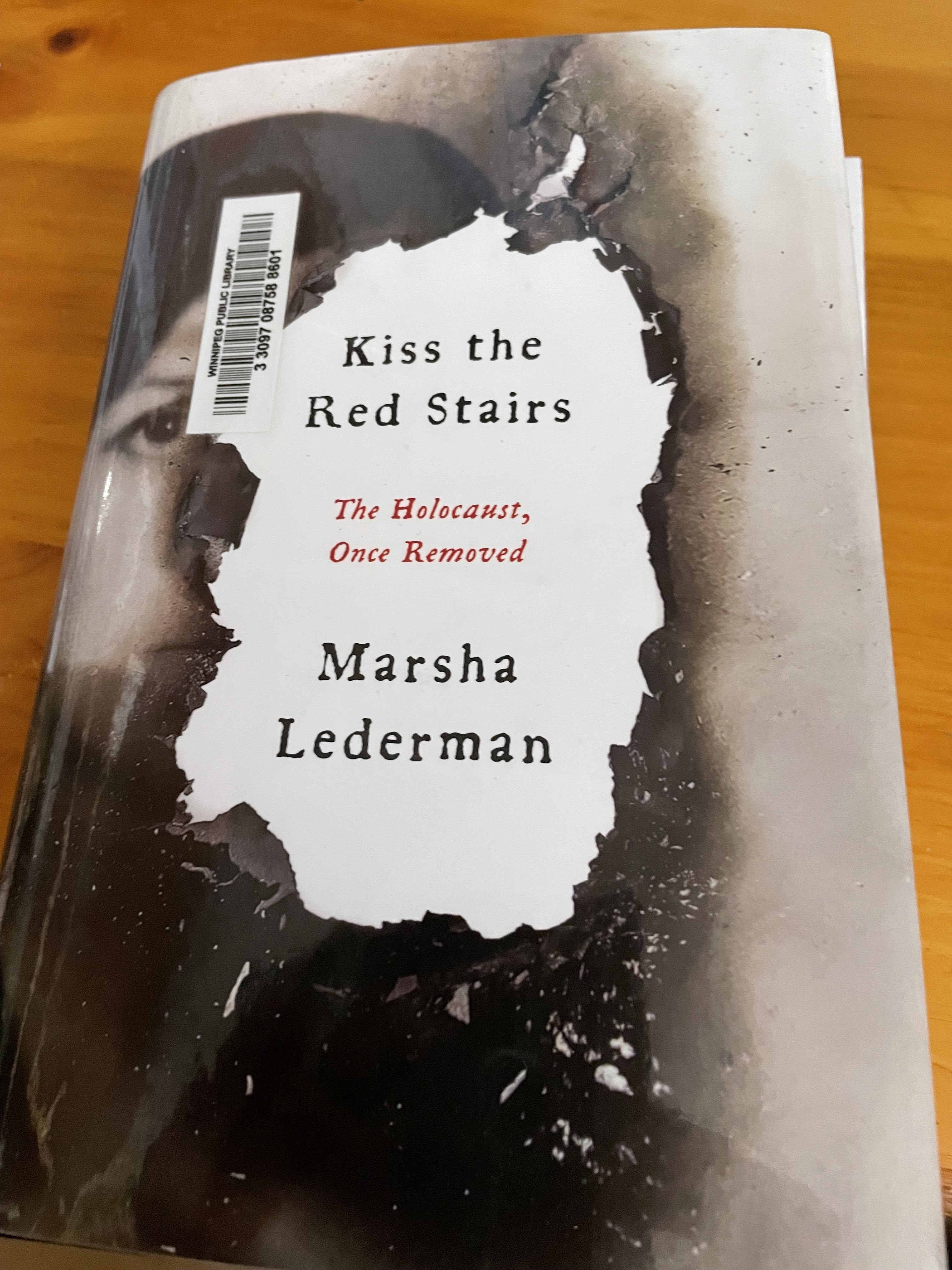
Reading Kiss the Red Stairs

I’ve been reading Kiss the Red Stairs and have mixed feelings about it. It’s very well-written, poignant and passionate. The author, Marsha Lederman, is a well-known Canadian journalist so I'd expected her research would be well-presented. With this memoir, she does a great job of connecting her life with her parents’ Holocaust memories. I also appreciate how she connects her losses to Indigenous and Black traumas.

I wasn’t quite as engaged with the trauma of her dysfunctional marriage. Perhaps I don’t see marriage as such an important part of selfhood. I'm someone who’s chosen not to wear my wedding ring, for complicated reasons, so her sadness about her ring-less fingers didn’t touch me at all. 

Like her, I also grew up without grandparents.  Perhaps I'm jealous about how much support she received as she explored her tragic family history. There’s no national day to remember the liquidating of the kulaks. No national memorial for the victims of the 1937/38 purges. My grandmother, dead of typhus in Yaya, Siberia has no gravestone. Neither does my baby uncle, dead on a boxcar during the long trip up to Yaya. Or my other uncle, dead while building the White Sea Canal. Numerous great uncles, aunts, shipped away to be forced labourers and never heard from again.  No recognition of their spent lives … not in Stalin's world. No reconciliation now in Putin's world.

As the daughter of a German father (a pilot for the Nazis) and a German-Russian mother, I grew up here in Canada feeling shame and embarrassment.  I grew up feeling that I was the daughter of bad people. Reading this memoir does nothing to alleviate that shame. I will never be good enough. I can’t erase who I am or who my parents were. 

I appreciated her expressions of gratitude ... something I'm also overwhelmed with.  I find reasons for it here in this democracy called Canada, in diverse friends and in rustic nature. 

One thing I have learned ... evil is not out there. Evil stares back at me in my own reflection. This knowledge keeps me humble. No righteous indignation in my life. 

I’m sure it was a cathartic experience for Lederman to research and write this book. And her honesty and vulnerability lends it power. But there was one more thing I was waiting for in this memoir … forgiveness.  She's a 2G —second generation Holocaust survivor—and I will always be guilty — the second generation perpetrator.  This is my inheritance and I must accept that with the help of Reinhold Niebuhr's 1932/3 written serenity prayer.


September's Gifts

This has got to be my most favourite time of year. September. The month of change, of harvest, of fragility. The month when the gift of summer still radiates from the tree’s fruit, from the earth’s vegetables, from the sky’s migrating birds. 

I live near two schools and on the sidewalks (yes, my neighbourhood has actual sidewalks!) youth saunter past—some with voices that trill with excitement—others who drag their soles (or is that souls?) with seeming dread. September and school ... positive possibilities for some; stress and anxiety for others.

There's also been a deathly tinge to my Septembers, like leaves that have changed colours. One of these deaths was my grandfather—executed during Stalin’s Great Terror in 1937. Discovering his interrogation papers and the exact date and time of his death (3:13 AM, September 19th, Zhytomyr) back in 2004 has added to the season's melancholy. 

September teases with cold, with hope, with decay, with potential. The compost pile grows bigger, promising to nurture  future lives and create new stories. Wishing everyone warm soup, warm socks and warm spaces to share stories.                                   


Recent Posts

Russians from Germany featured in New Fiction

English translation published by CMU Press I read two recently published works of fiction about Germans from Russia. Both authors had signin...